The idea is appealing: ride an electric bike, then recharge its battery using solar power. On paper, it's almost the perfect combination of soft mobility and renewable energy. In practice, the answer is more nuanced. Yes, charging an electric bike with solar panels is possible. But it's not always simple, quick, or truly practical depending on its use.
The real question is therefore not just "is it possible?", but rather "under what conditions is it a good idea?". For daily home use, solar can be very consistent if you already have a photovoltaic installation. For travel or camping, portable kits also exist, often with an intermediate power station. On the other hand, attaching a small panel directly to a bike hoping to quickly recharge a large battery remains, in most cases, quite limited.
Can an electric bike be charged with solar energy?
Yes, it's possible, but several cases need to be distinguished.
The simplest case, and by far the most realistic, is to produce solar electricity at home and then charge the bike with its usual charger from a standard outlet. Technically, the bike's battery doesn't "see" the solar panel directly. It is charged as usual, simply with electricity produced upstream by photovoltaics. For daily use, this is the cleanest and most comfortable solution.
The second case, more nomadic, involves using a portable solar panel to charge a power station, and then plugging the bike charger into it. This is currently the most credible solution for travel, camping, or long outings away from an outlet. Goal Zero, for example, offers 100W foldable panels and power stations with AC output, specifically designed for this type of off-grid use.
The third case is more technical: direct solar charging, via a DC station specifically designed for electric bikes. Research has shown that this architecture exists and works, but we are talking about a dedicated station with control electronics, not a simple panel rigged to the battery. In other words, yes to direct solar, but not without a truly adapted system.
Solar charging solutions for electric bikes
Here are the most realistic options today:
| Solution | Level of practicality | For what use? | Verdict |
|---|---|---|---|
| Home solar installation + original charger | Very high | Daily use | The best option for most people |
| Portable panel + power station | Good | Travel, camping, supplementary use | Relevant if you accept longer charging times |
| Dedicated solar station for e-bikes | Medium to low | Specific project, fixed site, experimentation | Interesting, but more technical |
| Small panel fixed directly to the bike | Low | Niche, prototypes, supplementary solar | More of a gadget than a primary alternative in most cases |
These benchmarks are based on e-bike charger charging times, the characteristics of 100W portable panels, power stations in the order of 499 to 677 Wh, and direct solar charging examples studied in technical literature.
For a typical cyclist, the most logical path remains the portable panel + intermediate battery duo. Why? Because the bike charger needs a stable and appropriate power supply. Bosch also reminds that its chargers are specific devices, with IP40 protection and not intended for outdoor use. In short, you first charge a solar energy reserve, then you properly charge the bike with its charger, dry and under good conditions.
If you want to better understand the charging logic of an e-bike battery, the BatooBike guide on how to charge your electric bike already provides a good basis. And to go further on capacity, lifespan, and best practices, the article on lithium electric bike batteries complements the topic very well.
The advantages of using solar panels for your bike

Solar has real advantages, provided you don't ask the impossible of it.
First, it provides a form of energy autonomy. For bikepacking, camping, or use far from an outlet, it's a real plus. You no longer depend solely on the grid, and you can recover energy throughout the day.
Second, it is environmentally consistent. An electric bike already consumes little compared to a car. If its charging also comes from a solar source, the whole becomes even more logical. This is particularly interesting for cyclists who already have photovoltaics at home.
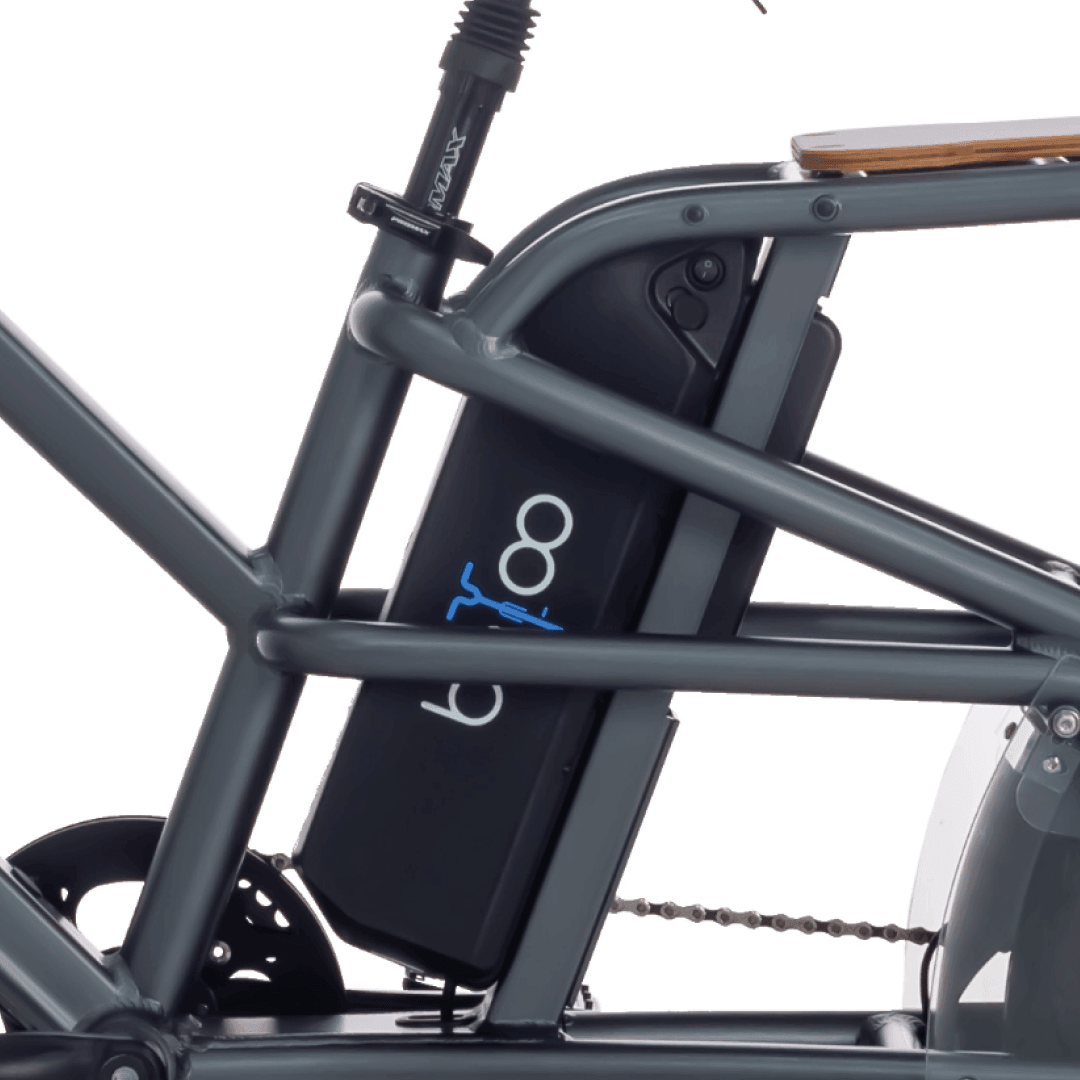
Finally, solar can be useful as a supplementary solution. It doesn't always replace a quick charge from the mains, but it can be enough to recover some autonomy, or to keep a power station ready for the next outing. On a cargo bike with a large battery, it can also make sense as a complement. For example, the Colibri carries a 720 Wh battery, which clearly shows that we are quickly talking about significant energy volumes on some modern bikes.
Limitations and constraints of solar charging
This is where we need to be honest: solar charging of an electric bike is almost always slower than charging from an outlet.
Bosch indicates, for example, that a PowerPack 500 battery takes about 4.5 hours to charge to 100% with a 4A charger, and about 7.3 hours with a 2A charger. For its part, Goal Zero announces that a 100W foldable panel can take about 6 to 12 hours to charge a 499 Wh Yeti 500 station, depending on conditions. This gives a very concrete order of magnitude: a single 100W portable panel can be useful, but it is more suitable for supplementary use than for a quick and systematic charge of an e-bike.
The weather also matters a lot. Portable solar depends on actual sunshine, orientation, temperature, and conversion losses. Two theoretically "sunny" days do not necessarily yield the same result. This is why when traveling, many cyclists use solar as a gradual input, and not as the only energy source they fully trust.
Weight and bulk must also be considered. A 100W foldable panel remains transportable, but it is not a small, invisible accessory. If you add a power station, the system becomes more versatile, but also bulkier and more expensive. For someone who mainly rides in the city and charges every evening at home, the interest quickly becomes limited.
Can solar panels be installed directly on an electric bike?

Technically, yes. Practically, for a classic bike, it's not the most convincing solution.
There are indeed solar-assisted vehicles with integrated panels. Evovelo, for example, presents a bio-hybrid vehicle with an integrated solar panel of at least 200W, a battery of at least 1200Wh, and an announced recovery of 5 to 10 km of range per hour of sun exposure. But this is no longer the classic urban e-bike that you park in front of the school or use to go to work every day. We are entering a more niche, bulkier, and more experimental category.
On a traditional electric bike, the available surface remains limited. This reduces the recoverable power, especially if the panel needs to remain compact, light, and compatible with riding. The result: the panel can help a little, but it rarely replaces a real charging solution. In most cases, it is better to consider onboard solar as a supplement, not as the core of the system.
When should you opt for solar charging for your electric bike?
Solar charging is a good idea if:
you are traveling, bivouacking, or camping with limited access to the grid
you already have a photovoltaic installation at home
you are looking for a supplementary solution, not necessarily an express charge
your daily mileage remains moderate and compatible with slow charges
It is less relevant if:
you need a fast and predictable charge every day
you ride with a large battery and little time available
you rely on a very small onboard panel to replace an outlet
you want a simple, lightweight solution without additional equipment
Ultimately, solar for electric bikes is a good idea, but not for everyone or for all uses. At home, it's excellent if you charge your bike with already produced solar electricity. When traveling, it's relevant with a well-designed kit. On the other hand, for direct, fast, and ultra-simple charging, the solar panel remains a niche solution rather than a standard.
Final FAQ
Can an electric bike battery be charged with a solar panel?
Yes, it is possible. The simplest way is to use either a domestic photovoltaic installation or a portable panel combined with a power station, and then plug in the bike's usual charger. Direct solar charging also exists, but via more technical dedicated systems.
How long does it take to charge an e-bike with a solar panel?
This mainly depends on the panel's power, the battery's capacity, and the actual sunlight. As a rough estimate, a 100W portable panel can take 6 to 12 hours to fill a station around 499 Wh, whereas a 500 Wh Bosch battery charges in about 4.5 hours from the mains with a 4A charger.
What solar equipment should I use to charge an electric bike while traveling?
The most realistic option is a kit consisting of a foldable solar panel, a power station with AC output, and then the bike's original charger. This is currently the most practical solution for travel or camping.
Can solar panels be installed directly on an electric bike?
Yes, but it remains uncommon and often not cost-effective on a classic bike. The available surface is limited, so the recovered power is also limited. In most cases, it remains a supplementary solution rather than a true alternative to conventional charging.
Are there solar-assisted electric bikes?
Yes, there are projects and vehicles with integrated solar panels. However, these are more specialized models than the standard urban e-bike, with a still rather niche positioning.
Is solar a good idea for all cyclists?
No. For daily urban use with an outlet available, conventional charging is often simpler. Solar becomes particularly interesting for autonomy, travel, energy supplement, or domestic use coupled with a photovoltaic installation.