A cargo bike can replace many car journeys, but its size quickly becomes a decisive factor when living in a city, an apartment, or a building with a narrow bike storage area.
This is precisely where the compact cargo bike becomes interesting. It aims to maintain a true transport capacity while limiting the length, width, or overall bulk of the bike.
However, the word "compact" alone is not a guarantee. Two bikes presented as compact can be very different in length, family capacity, and ease of storage.
Therefore, the best compact cargo bike is not necessarily the smallest: it's the one that carries what you need while easily fitting through your doors, around your corners, in your bike storage area, and on your daily commutes.
What exactly is a compact cargo bike?
There isn't a universal dimension at which a cargo bike officially becomes "compact."
In practice, this term generally refers to a cargo bike designed to reduce its bulk compared to traditional large two-wheeled or three-wheeled cargo bikes.
This compactness can result from several elements:
- reduced overall length;
- a shorter wheelbase;
- a more compact family box;
- small-diameter wheels;
- a narrower handlebar;
- geometry that facilitates maneuvering;
- a design optimized for urban parking.
A compact cargo bike can be a two-wheeled cargo bike, a longtail, or another intermediate format. Therefore, "compact" should not be confused with a unique bike category.
What dimensions should be considered before purchase?
Overall length is important, but it's not enough.
To determine if a cargo bike truly fits a small space, check at least:
- the total length;
- the maximum width;
- the handlebar width;
- the maximum height;
- the turning radius;
- the space needed to deploy the kickstand;
- the length required to maneuver it on foot.
These measurements must then be compared to your actual environment.
Measure the doors
Measure the door of the bike storage area, garage, courtyard, or building at its narrowest point.
Don't forget:
- the handle;
- the door frame;
- any door closers;
- radiators or objects placed just behind;
- the space needed to hold the door open while pushing the bike.
Measure the turns
A sufficiently wide door does not guarantee that the bike can reach its location.
A long cargo bike can be blocked by a 90-degree turn in a corridor even if the door itself is wide enough.
So, check:
- the width of the corridor;
- the distance between the door and the first turn;
- the available space to pivot the front wheel;
- the presence of walls, posts, or other bikes.
Measure the floor space
You also need to allow enough space to use the bike, not just to store it.
You should be able to:
- put it on its kickstand;
- access the battery;
- install children;
- attach the frame to a fixed point;
- take it out without moving several other bikes.
Why is a compact cargo bike interesting in the city?
Compactness primarily offers advantages in situations where space is limited.
A compact model can facilitate:
- U-turns;
- maneuvers in a courtyard;
- storage in a bike room;
- passage through certain doors;
- parking among other bikes;
- moving on foot;
- navigating narrow streets.
This difference may seem minor during a ten-minute test ride. It becomes much more significant when you have to take the bike in and out two or four times a day.
Does compact necessarily mean more maneuverable?
Not automatically.
Length plays a role, but maneuverability also depends on:
- the frame geometry;
- the wheelbase;
- the steering angle;
- the wheel diameter;
- the handlebar width;
- the weight distribution;
- the load transported.
A relatively short but front-heavy bike may require more effort in certain maneuvers than a slightly longer but very well-balanced model.
This is why the technical specifications never replace a test ride.
How to test the maneuverability of a compact cargo bike?
During the test ride, don't just ride in a straight line.
Test:
- a sharp left turn;
- a sharp right turn;
- a U-turn;
- a slow slalom;
- a complete stop and restart;
- maneuvering on foot;
- backing up by pushing the bike;
- putting it on the kickstand in a confined space.
Perform these tests empty, then with a representative load.
You can use our complete checklist for testing a family cargo bike to structure your test.
Can a compact cargo bike carry children?
Yes, if it has been designed and approved for this use.
Compact does not necessarily mean single-seater or low capacity.
Depending on the model, a compact cargo bike can carry:
- one child;
- two children;
- children with groceries;
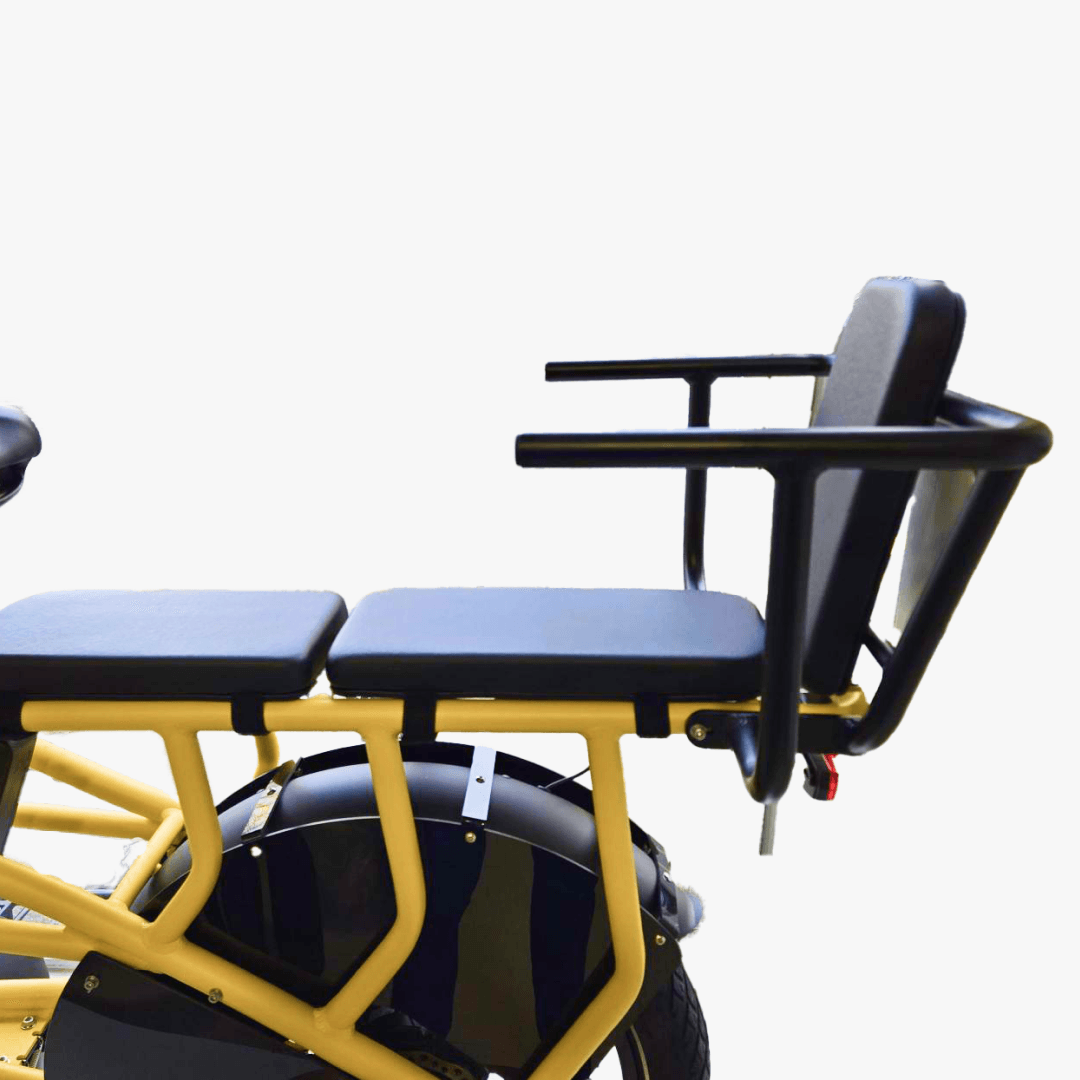
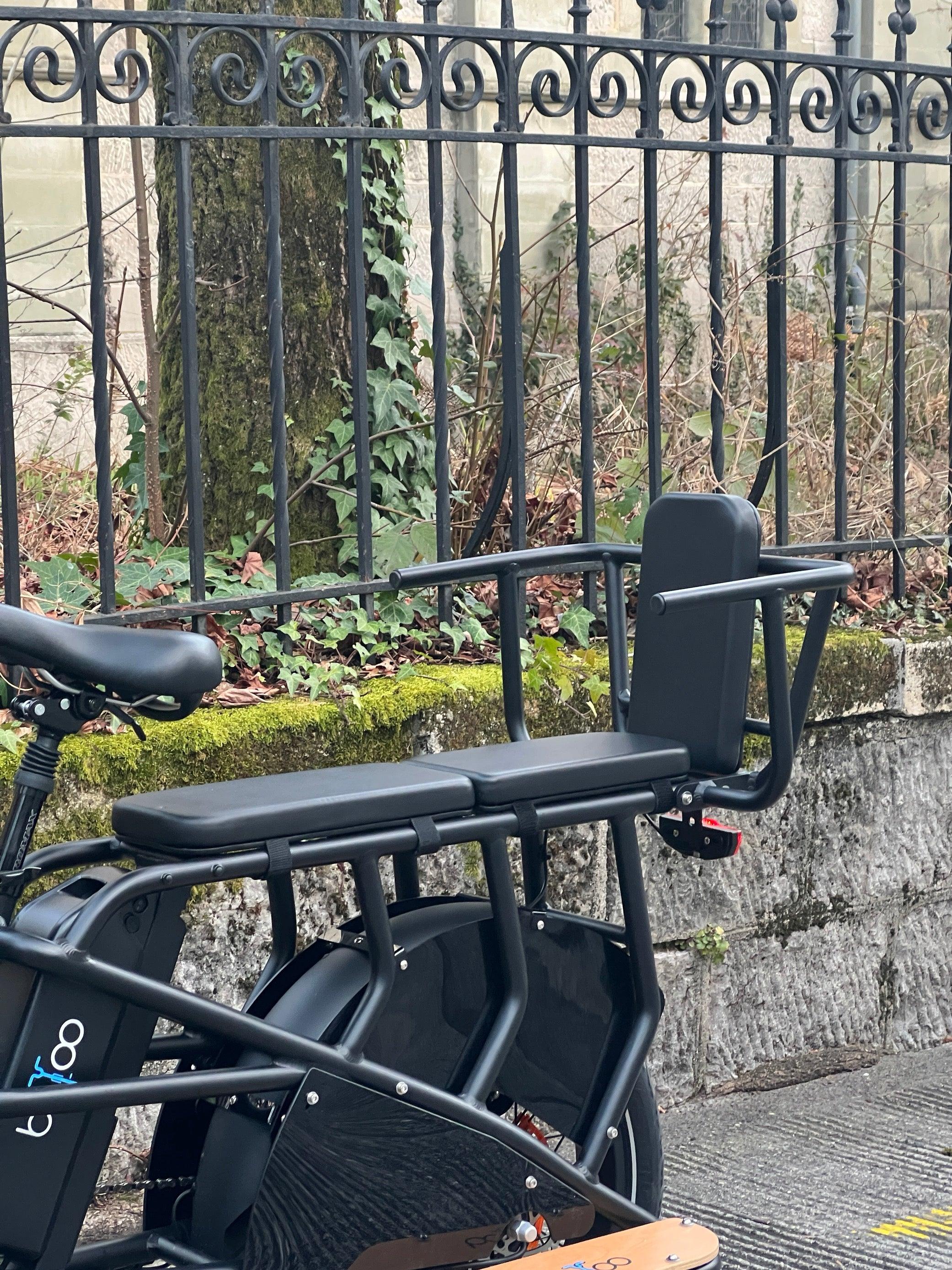
- a combination of seat and bench provided by the manufacturer.
The real question is therefore less "how many seats are advertised?" than:
- how many seats are officially provided?
- what is the payload?
- how much width remains available for shoulders?
- where do the children's legs go?
- where to place school bags?
- what space is left for groceries?
The main compromise: children or cargo volume
Reducing the size sometimes requires compromises.
A shorter box can perfectly carry two children, but leave less space for:
- school bags;
- a sports bag;
- groceries;
- a compact stroller;
- rain gear.
Before purchasing, therefore, reproduce your actual load.
If you transport two children every day, ideally come to the test with them and their bags.
A bike that seems spacious with two children without luggage can become much less practical on a Monday morning with two school bags, rain gear, and return groceries.
Compact or longtail: which takes up less space?
The longtail is often one of the simplest formats to integrate into an environment designed for conventional bicycles.
It generally maintains a width similar to that of a traditional bicycle and primarily extends the rear rack.
A compact two-wheeled cargo bike remains different: its box is located at the front and the bike can be longer than a longtail, but it can offer more family volume.
| Criterion | Compact cargo / compact two-wheeled cargo bike | Longtail | Large two-wheeled cargo bike |
|---|---|---|---|
| Width | Moderate depending on the box | Often similar to a conventional bicycle | Variable depending on the box |
| Length | Reduced compared to some two-wheeled cargo bikes | Often relatively compact | Often larger |
| Visible children | Yes with front box | No, passengers behind | Yes |
| Box volume | Medium | No front box | More significant |
| Narrow bike storage | To be measured | Often advantageous | More demanding |
| Groceries + children | Good compromise depending on model | Panniers often necessary | Generally large capacity |
For a complete comparison of formats, consult our guide longtail, two-wheeled, or three-wheeled cargo bike: which cargo bike to choose?.
Is a compact cargo bike easier to park?
Often yes, but only if its dimensions match your location.
A shorter bike can facilitate:
- parallel parking against a wall;
- lengthwise parking spots;
- maneuvering between several bikes;
- entering a garage;
- U-turns.
A reduced width can, in turn, facilitate:
- passing through doors;
- communal premises;
- storage between two bikes;
- access through certain gates.
Find our complete guide on parking a cargo bike in the city.
Can a cargo bike be stored in an apartment?
Technically, some models can fit into an apartment. But the real question is whether this solution remains practical every day.
First, check:
- the existence of an elevator;
- the dimensions of the cabin;
- the width of the doors;
- the space to pivot the bike;
- the presence of steps;
- the available space in the apartment.
An electric cargo bike is heavy. The fact that it is compact does not mean that it is designed to be carried up stairs.
If your accommodation is on an upper floor without an elevator, daily storage in the apartment will rarely be the simplest solution.
Can a cargo bike be stored vertically?
Only if the manufacturer explicitly authorizes this method.
Do not assume that a cargo bike can be placed vertically simply because some conventional bicycles allow it.
You must take into account:
- the weight of the bike;
- the shape of the box;
- the support points;
- the brakes;
- the battery;
- the accessories;
- the manufacturer's recommendations.
If the manufacturer does not provide for vertical storage, opt for classic floor storage.
Why do many compact cargo bikes use 20-inch wheels?
Small wheels can help manufacturers reduce certain elements of the size and position the load lower.
On a cargo bike, a low loading position is interesting because it can facilitate handling of the bike when transporting children or heavy objects.
20-inch wheels also allow space for a box or platform without excessively increasing the height of the bike.
Are 20-inch wheels less comfortable?
Not necessarily.
Wheel diameter is only one element of comfort.
You also need to consider:
- the tire width;
- its air volume;
- the pressure used;
- the bike's geometry;
- the presence of suspension;
- the type of road surface;
- the speed.
A wide, correctly inflated tire can absorb some small irregularities. A suspension fork can also improve comfort at the front depending on the bike.
However, small wheels require more attention on large curbs, holes, or significant obstacles.
Should you choose a compact cargo bike only for its small wheels?
No.
Two bikes using 20-inch wheels can have completely different dimensions and behaviors.
Prioritize comparing:
- the total length;
- the width;
- the wheelbase;
- the turning radius;
- the payload;
- the space for children;
- the behavior during the test ride.
Does compact mean less range?
No. The external size of the bike does not directly determine the range.
Range primarily depends on:
- the battery capacity;
- the total weight;
- the terrain;
- the level of assistance;
- the temperature;
- the wind;
- the tires;
- stops and starts.
A compact cargo bike can therefore have a significant battery and offer a range suitable for family journeys.
Conversely, a large cargo bike with a small battery will not automatically have better range.
To correctly estimate your needs, consult our guide on the real range of a loaded cargo bike.
Does compact mean less payload?
Not necessarily either.
Load capacity depends on the frame, components, and limits defined by the manufacturer, not solely on external dimensions.
A relatively compact bike can therefore have a significant payload.
But two concepts must be distinguished:
- the available payload;
- the volume actually available for this load.
A bike can support a lot of weight while offering a relatively compact box.
For a family, therefore, both weight and space must be checked.
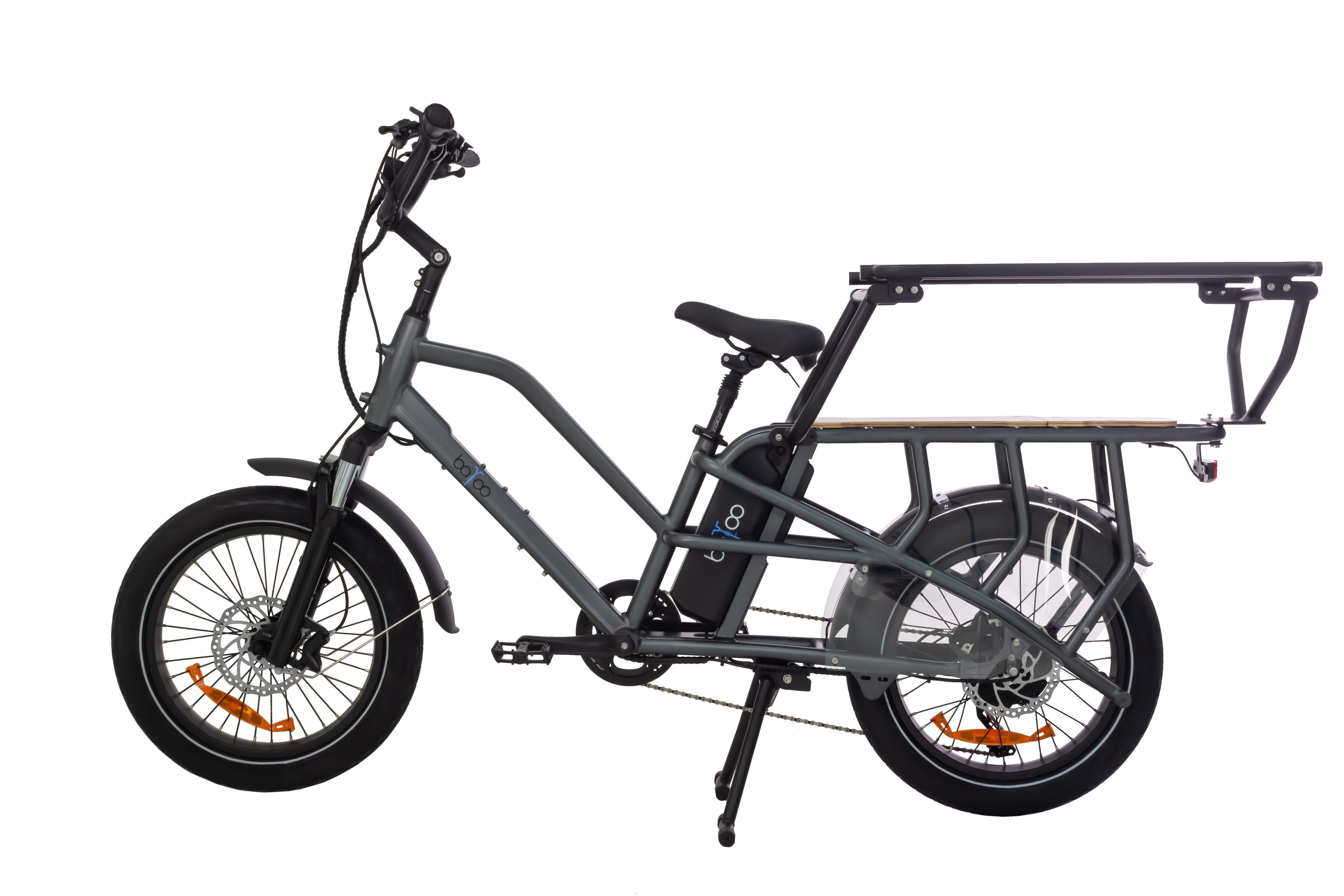
Is the Colibri V2.0 a compact cargo bike?
The current specification sheet for the Colibri V2.0 presents it as a "compact and powerful" cargo bike intended for daily family use.
The 2026 model notably features:
- a low frame;
- a Bafang 500 W and 85 Nm motor;
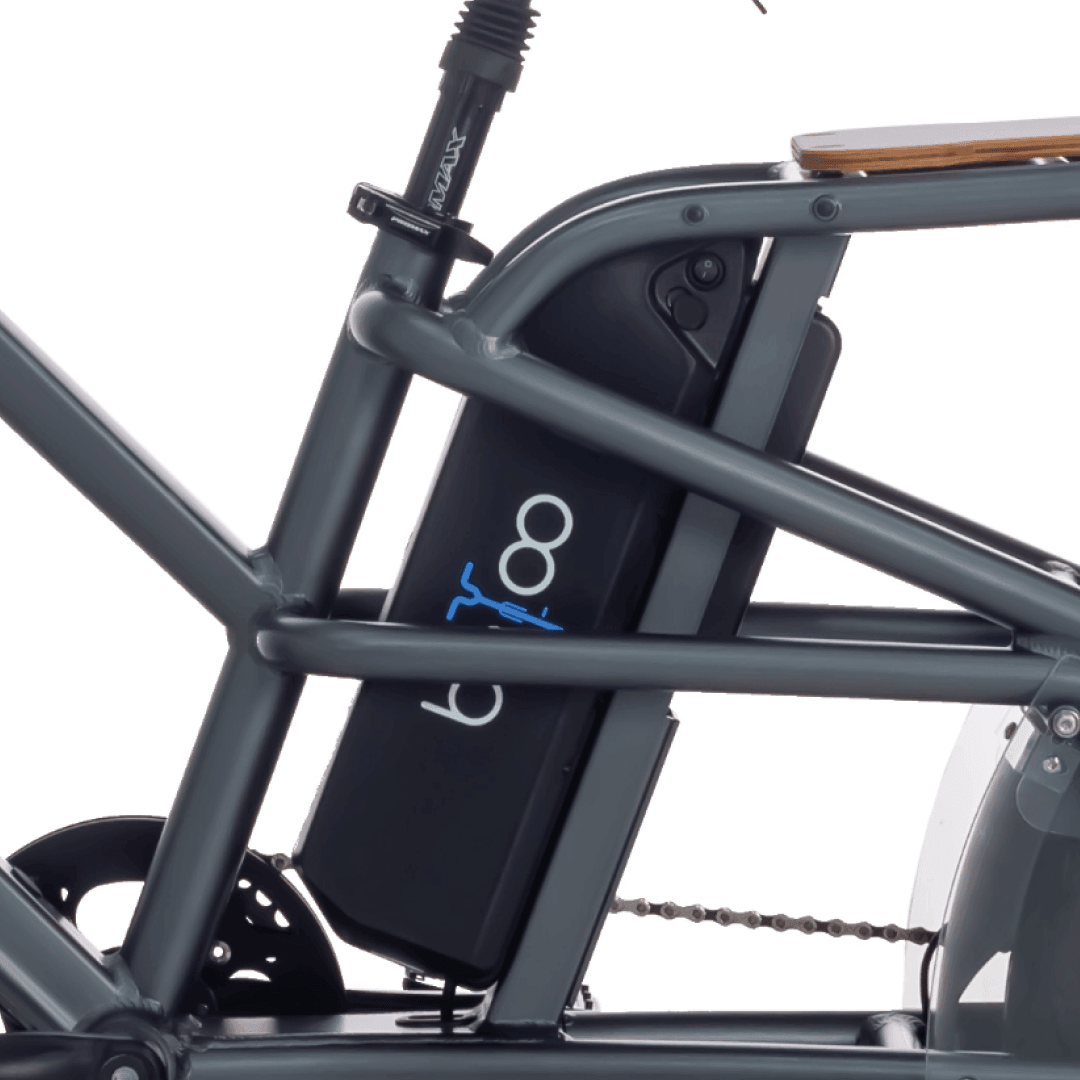
- a removable 720 Wh battery;
- a dual battery option of 1,440 Wh;
- CST 20 × 3.0 tires;
- a suspended front fork;
- four-piston hydraulic brakes;
- an announced payload of up to 160 kg;
- a telescopic seat post and adjustable handlebar;
- GPS and anti-theft functions with geofencing.
These features are interesting for urban use, but the word "compact" should never replace a physical check.
Before choosing the Colibri or another model, measure your space and compare the bike's actual dimensions to the available space.
Who is a compact cargo bike particularly suited for?
Families living in apartments
A contained format can be particularly interesting when the bike has to pass through a common door, a courtyard, or a shared storage area.
City center residents
A reduced turning radius and an easy-to-maneuver bike can simplify daily tasks.
Families with one or two children
When the offered capacity meets the needs, a compact model can prevent you from buying something much larger than necessary.
People replacing a second car
The bike must then remain available and easy to use every day. A model that is simple to store can become more practical than a cargo bike offering more volume but difficult to take out.
People with a small garage
A few tens of centimeters can make the difference between a bike that is easy to park and a model that requires moving the car or other equipment.
When is it better to choose a larger cargo bike?
The compact is not always the best choice.
A larger model may be preferable if you regularly transport:
- three or four children;
- large grocery shopping at the same time as the children;
- bulky professional equipment;
- sports equipment;
- loads requiring a large box.
If your home has a spacious garage and size is not a constraint, sacrificing volume just to gain a few centimeters is not necessarily relevant.
Checklist to measure at home before purchasing
- ☐ Width of the main door.
- ☐ Width of the bike storage room.
- ☐ Length of the floor space.
- ☐ Available space to deploy the kickstand.
- ☐ Width of the corridors.
- ☐ Turning radius available in corners.
- ☐ Elevator dimensions if necessary.
- ☐ Height of any obstacles.
- ☐ Presence of stairs.
- ☐ Possibility of attaching the frame to a fixed point.
Checklist to test at the dealer
- ☐ The bike is easy to push.
- ☐ I can make a U-turn in a small space.
- ☐ The kickstand is easy to use.
- ☐ Children have enough space.
- ☐ School bags have a logical place.
- ☐ There is still room for some groceries.
- ☐ I can easily control the bike at low speed.
- ☐ Tight turns are natural.
- ☐ I can move it backward on foot.
- ☐ The bike remains maneuverable with a real load.
- ☐ I know its exact length and width.
- ☐ Its dimensions correspond to those of my storage space.
Conclusion
A compact cargo bike can be an excellent choice for the city, but only if its capacity truly meets your needs.
Its main advantage is to strike a better balance between transport and bulk: enough space for children or groceries, without turning every entry into the bike room into a complicated maneuver.
However, don't rely solely on the word "compact." Measure the length, width, doors, hallways, and turning space.
Also compare the payload, children's space, bag storage, and how the bike handles when loaded.
If you live in the city or have limited space, a few measurements taken before purchase can be as important as the motor or battery.
Book a test ride and check the bike's size in your actual setup
Frequently asked questions about compact cargo bikes
Which cargo bike takes up the least space?
Longtails are often among the easiest cargo bikes to integrate into a space designed for classic bicycles, while some compact two-wheel cargo bikes offer more family volume with a reduced footprint. Always compare exact dimensions rather than the category name.
Can a compact cargo bike carry two children?
Yes, if the manufacturer provides two suitable seats and if the payload allows for this configuration. Also check for legroom, shoulder room, harnesses, school bags, and groceries.
Are 20-inch wheels comfortable?
They can be. Comfort also depends on tire width and pressure, bike geometry, suspension, and road surface. A wide, properly inflated tire can provide a good level of comfort on a cargo bike.
Can a cargo bike be stored in an apartment?
It depends on the weight, dimensions, doors, elevator, and available space. A compact model can facilitate storage, but an electric cargo bike is still heavy and is generally not designed to be carried up stairs daily.
Does a compact cargo bike have less range?
Not necessarily. Range primarily depends on the battery, total weight, terrain, assistance level, weather, and tires. The external size of the bike alone is not enough to determine its range.