When buying an e-bike, we often think about the motor, comfort, and design… then we quickly realize that everything also (and sometimes primarily) depends on the battery. It dictates the actual range, the charging frequency, the bike's performance under load, and a significant aspect of everyday safety.
This article covers the topic of “lithium batteries” without unnecessary jargon: how they work, why they have become the standard, how long they last, how to maintain them, what the risks are, and what to do at the end of their life.
What is a lithium-ion battery for an electric bike?
A lithium-ion battery (often called “Li-ion”) is a set of rechargeable cells housed in a casing, along with control electronics. In an electric bicycle, it provides power to the motor and the assistance system, but it also serves to stabilize the power output according to the effort required.
Two simple ideas help to understand:
-
Capacity is often expressed in Wh (Watt-hours) : the more Wh there is, the larger the energy reserve (therefore more potential autonomy).
-
The battery is not “just” a reservoir: it incorporates a management system (BMS) that monitors charging/discharging, protects the cells and limits certain risky behaviors.
Why do electric bikes use lithium batteries?

Lithium-ion batteries have become the standard because, for similar usage, they offer an excellent compromise between range and weight. In practical terms, this allows for more compact batteries that are easier to integrate into a frame and more pleasant to use on a daily basis (especially in the city or while trekking).
Another important point: charging is more flexible. You can charge "a little" between two trips without waiting to be completely flat, which corresponds well to the reality of usage (commuting to work, shopping, trips to school, etc.).
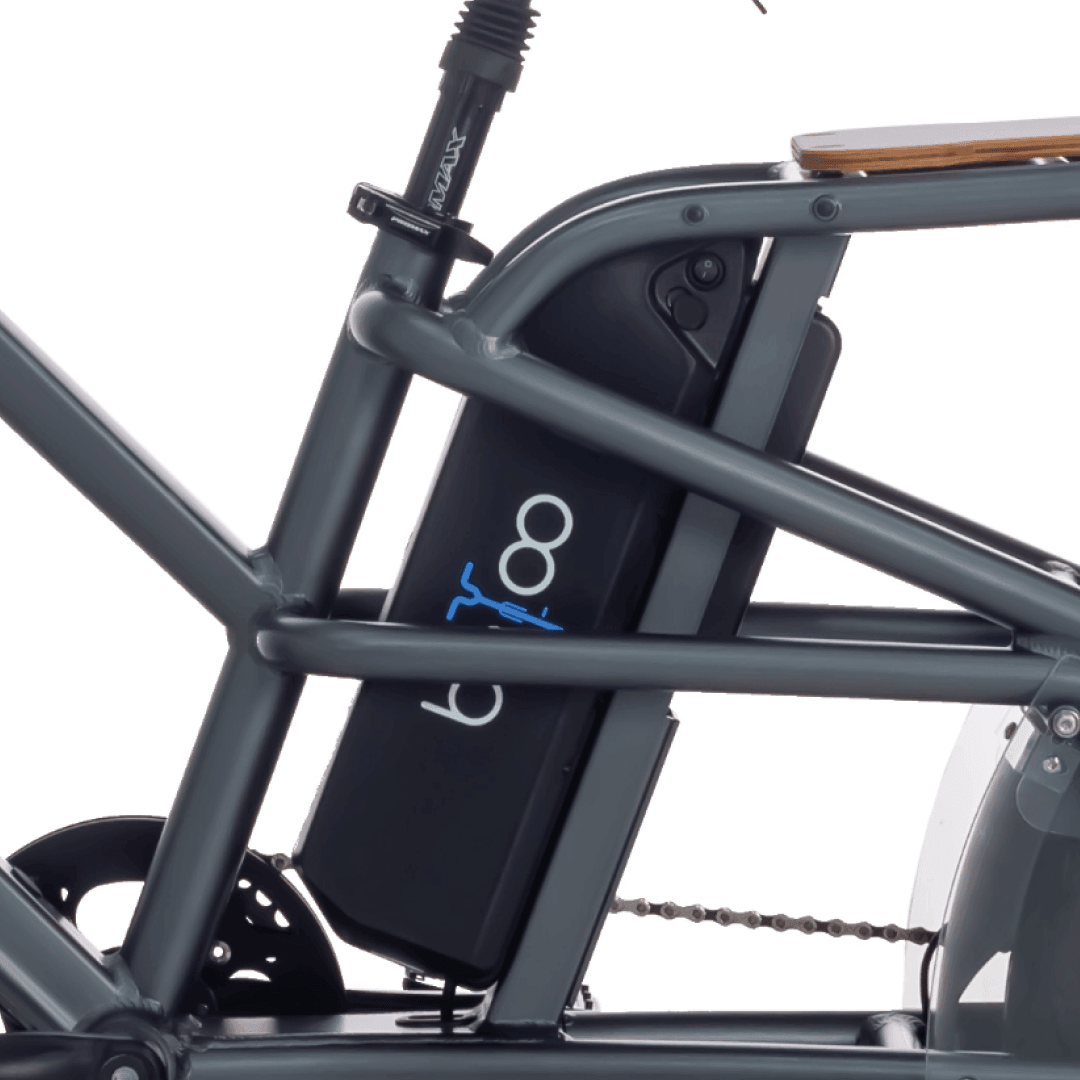
To illustrate what you find on an urban bike, the product page for lithium electric bike batteries indicates, in particular, an order of magnitude of charging time on a standard outlet and the fact that the battery can be removed for easier charging (practical when living in an apartment).
What is the lifespan of a lithium battery for an electric bike?
Battery life depends less on a single figure than on actual usage. Over time, a battery gradually loses capacity: it's not a complete failure, but rather a gradual decrease in battery life.
What makes a battery "age" the most:
-
extreme heat (storage in a very hot place, car in the sun, overheated room),
-
repeated very deep discharges,
-
prolonged storage with a completely empty or completely full battery
-
very demanding uses (steep hills, heavy load, maximum continuous assistance).
The signs that often occur when a battery is nearing the end of its life: significantly reduced battery life, abnormal charging time, or erratic behavior (cutouts, percentages dropping too quickly).
How to properly maintain a lithium battery to prolong its lifespan?
Maintaining a Li-ion battery is mainly a matter of simple, regular habits that are easy to maintain in real life.
On a daily basis, the best approach is to avoid extremes: don't try to completely drain the battery too often, and don't leave it at 100% for days if you're not driving. Recharging after your trip, in a dry and temperate place, remains a healthy routine.
In winter or during extended periods of inactivity, proper storage is crucial: a dry place at a moderate temperature is best, and the battery should be neither fully charged nor completely empty. As for cleaning: avoid high-pressure jets, keep the connectors clean and dry, and handle the battery gently.
If your needs require more range (cargo, long distances, hilly terrain), a simple solution could be to have a second, dedicated battery. The product page for lithium batteries for electric bikes presents the idea of an additional battery to extend your range without changing your riding habits.
Can a lithium battery catch fire or explode?

Yes, it's possible, although rare with reliable equipment and normal use. The risk increases especially when there is:
-
a damaged battery (drop, impact, deformation),
-
an incompatible charger
-
poor quality, counterfeit, or modified products.
The warning signs to take seriously are fairly obvious: a swollen battery, abnormal heat, unusual odor, noises (whistling/crackling), unusual charging (very long, incomplete charging), or smoke. In these cases, stop using the battery and have it checked.
How to recycle the lithium battery of an electric bike at the end of its life?
In Switzerland, a Li-ion battery must not end up with household waste. It must be taken to a collection point (store/collection point) to limit the risk of fire and allow for the recycling of materials.
In practice, the idea is simple: as soon as a battery is at the end of its life or has a problem, avoid keeping it "at the back of the garage" and remove it properly.
FAQ
What is a lithium-ion battery for an electric bike?
It's a rechargeable battery designed to power the motor and the assistance system. It's primarily compared based on its capacity (often expressed in Wh), which directly influences the potential range.
Why do electric bikes use lithium batteries?
Because they offer a good battery life/weight ratio and charging adapted to daily use (partial charging possible, compact size, good performance).
What is the lifespan of a lithium battery for an electric bike?
It depends on usage (temperature, heavy loads, terrain, charging habits). In general, the battery life decreases gradually: this is often the first sign that the battery is aging.
How to properly maintain a lithium battery to prolong its lifespan?
Avoid extremes (very low and very high), recharge in a dry and temperate place, store properly in case of long breaks, and protect the battery from shocks and moisture.
Can a lithium battery catch fire or explode?
Yes, especially in the case of an incompatible charger, defective/counterfeit products, or a damaged battery. Safety recommendations and warning signs (abnormal heat, swelling, odor, noises, abnormal charging, smoke) are detailed by the London Fire Brigade via #ChargeSafe .
How to recycle the lithium battery of an electric bike at the end of its life?
In Switzerland, INOBAT reminds people that a damaged/deformed battery must be taken to a staffed collection point, and recommends simple precautions such as covering the terminals with adhesive tape to limit short circuits (and, if necessary, insulating the battery).