Can you take a cargo bike on the train in Switzerland? Yes, but not on all trains.
SBB considers cargo bikes to be special bikes. On the SBB network, they can only be transported on RegioExpress (RE), S-Bahn/RER (S), and Regio (R) trains, subject to available space.
On the BLS, RhB, and SOB networks, special bikes may also be permitted on certain InterRegio (IR) trains, again subject to sufficient space.
This notably means that a cargo bike is not permitted on an SBB InterCity train simply because that train has space for regular bicycles.
Before each trip, therefore, check the train category in the SBB timetable, any restrictions indicated for the route, and the actual possibility of loading your bike.
Quick answer: can a cargo bike be put on an SBB train?
| Train category | Cargo bike on SBB network | Note |
|---|---|---|
| R / Regio | Yes | Subject to available space |
| S / RER | Yes | Subject to space and local timetable restrictions |
| RE / RegioExpress | Yes | Subject to available space |
| IR / InterRegio SBB | No | Special bikes are not permitted on IR trains operated by SBB |
| IC / InterCity SBB | No | Even if the train has space for regular bicycles |
| EC / EuroCity SBB | No | Space and safety restrictions for special bikes |
On BLS, RhB, and SOB, cargo bikes and other special bikes may also be transported on IR trains where space allows.
Therefore, you need to look not only at the train category but also at the operating company.
Why do cargo bikes have different rules?
A cargo bike generally takes up more space than a conventional bike and cannot always be placed in the hooks or fastening systems provided on trains.
SBB groups the following under the category of special bikes:
- tandems;
- long recumbent bikes;
- certain tricycles;
- cargo bikes;
- other bikes over two meters in length.
The problem is therefore not only weight. Length, width, fastening possibilities, and available space in the vehicle are also decisive.
Does the two-meter limit apply to all cargo bikes?
The two-meter rule is often misunderstood.
SBB separately lists cargo bikes and other bikes over two meters as special bikes.
Therefore, it should not be assumed that a cargo bike under two meters automatically becomes a regular bike allowed on all trains.
Before the trip, however, note down the dimensions of your bike so you can answer accurately if staff or the transport company asks for its size.
Preferably measure the bike in its travel configuration:
- total length;
- maximum width;
- box width;
- handlebar width;
- any fixed accessories.
Is a cargo bike accepted on an InterCity train?
Not on InterCity trains operated by SBB.
This is a particularly important point, as travelers sometimes see a bike pictogram in an IC timetable and assume that their cargo bike will also be accepted.
This pictogram may concern conventional bikes compatible with the spaces provided on the train.
A cargo bike remains subject to the rules for special bikes.
On the SBB network, therefore, you should look for an alternative on:
- RE;
- S;
- R.
The journey may be longer or require more connections, but it will be compatible with the train categories authorized for special bikes.
What about on a BLS, RhB, or SOB InterRegio train?
The rule is different.
SBB indicates that BLS, RhB, and SOB also allow special bikes on their InterRegio trains, provided there is sufficient space.
This detail can open up more possibilities on certain routes.
However, it remains essential to consult the timetable for the specific journey before departure, as other restrictions may apply.
How to find a train that accepts bikes?
In the SBB timetable, use the extended search and activate the option:
"Bikes allowed (in Switzerland only)"
This function helps to exclude many routes that do not accept bikes.
For a cargo bike, a second manual check is then required: look at the train category.
For an SBB journey, prioritize looking for:
- RE;
- S;
- R.
Therefore, do not rely solely on the bike pictogram.
SBB Checklist before booking your journey
- Search for your journey in the SBB timetable.
- Activate "Bikes allowed" in the extended search.
- Check the category of each train.
- Identify the company operating the train.
- Check for any restrictions indicated in the timetable.
- Avoid an SBB route including an IC or IR if you are traveling with a cargo bike.
- Allow sufficient time for connections.
- Travel outside peak hours if possible.
What ticket do I need to buy for a cargo bike?
The rider must have their own valid ticket, and the bike also requires a valid ticket on routes where bike transport is offered.
For many journeys in Switzerland, the main options are:
| Product | Price / Principle | For what use? |
|---|---|---|
| Bike route ticket | 2nd class half-fare ticket for the route | Relatively short journey |
| Bike day pass | CHF 15.– | Day with several journeys or a longer journey |
| Bike pass | CHF 260.– per year | Regular travel with a bike |
For a short journey, the route ticket may be more advantageous. As soon as the price of the bike ticket reaches CHF 15.–, the day pass usually becomes the option to compare.
However, the transport company's conditions remain a priority for a special bike.
Do I need to reserve a spot for a cargo bike?
Not systematically.
SBB requires reservations for bikes on certain categories and routes, notably some IC trains during the cycling season.
But a cargo bike is precisely not allowed on SBB IC trains.
Trains that do not display the bike reservation symbol do not allow reservations.
With a cargo bike, this means you may have the necessary ticket without having the guarantee that there will be enough space at the time of departure.
Transport remains subject to available capacity and staff instructions.
This is an important difference compared to a seat reservation: buying a bike ticket does not automatically guarantee a physical space for a cargo bike.
Why avoid peak hours?
A cargo bike uses more space and is harder to move quickly when a train is already crowded.
If your schedule is flexible, choose a less busy connection.
SBB particularly indicates restrictions on bike transport on certain lines during peak hours.
In the Zurich S-Bahn, for example, bike loading is restricted from Monday to Friday between 6 am and 8 am and then between 4 pm and 7 pm according to the timetable indications.
Restrictions also exist on some Ticino routes.
The best reference therefore always remains the timetable for the day of travel.
How to load a cargo bike onto the train?
SBB's general principle is clear: you must be able to load and unload your bike yourself.
Before the train arrives:
- locate the section where the bike space is located when this information is available;
- arrive at the platform early enough;
- remove easily detachable luggage;
- prepare children before the train arrives;
- keep entrances and passageways clear.
SBB also asks to remove luggage attached to the bike when it reduces available space or may compromise its stability.
Do I need to remove the e-bike battery?
For simple loading by the traveler onto the train, SBB's general information does not require systematically removing the e-bike battery.
In practice, removing it can nevertheless reduce the bike's weight during difficult handling if the manufacturer allows this operation.
If you remove the battery:
- transport it carefully;
- protect the contacts;
- avoid shocks;
- do not leave it unattended.
Never disassemble an electrical component if you are not familiar with the procedure specified by the manufacturer.
Do I need to remove panniers and luggage?
Yes, it is recommended and SBB asks to remove luggage when it takes up space or can destabilize the bike.
So, prepare for your trip with bags that are easy to detach.
A good setup could be:
- one bag per adult;
- school bags that are easy to remove;
- no loose items in the box;
- small accessories grouped before the train arrives.
The lighter and more stripped down the bike, the easier boarding will be.
Traveling by train with a cargo bike and children
With children, the most difficult part is not necessarily the train journey: it's often boarding and changing connections.
Avoid an arrangement where one person has to simultaneously:
- supervise two young children;
- carry several bags;
- handle a heavy cargo bike;
- find the right space on the train.
When two adults travel together, assign roles before the train arrives.
For example:
- one adult accompanies the children;
- the other takes care of the bike;
- luggage is already removed from the cargo bike;
- everyone knows which carriage to board.
How much time should I allow for a connection?
With a cargo bike, avoid very short connections.
Sometimes you need to:
- get off through a different door;
- cross a platform;
- take a ramp or an elevator;
- change sectors;
- reload children and luggage.
SBB itself recommends allowing sufficient time upon arrival and during changes when traveling with a bicycle.
With a family cargo bike, this margin becomes even more important.
Beware of station elevators
A cargo bike may be accepted on the train but difficult to move around in some stations.
Before a complex journey, check if your bike can:
- enter the elevator;
- turn in front of its doors;
- pass over ramps;
- be easily pushed through available passages.
This question is particularly important with a very long two-wheeled cargo bike or a wide three-wheeled cargo bike.
Is a longtail considered a special bike?
That depends on its exact type and dimensions.
SBB explicitly classifies cargo bikes as special bikes and also classifies other bikes over two meters as special.
A longtail designed and marketed as a cargo bike may therefore fall under these rules. A model over two meters will in any case be subject to the length rule.
If in doubt, check the dimensions of the model and ask for confirmation from the company operating your train.
What to do if the train is full?
Even on a route where cargo bikes are allowed, their transport is not guaranteed if there is insufficient space.
Staff may restrict loading for capacity or safety reasons.
You must then be prepared to:
- take the next train;
- choose another route;
- modify a connection;
- leave the bike safely at the station;
- opt for a rental solution at your destination.
With young children, plan for this possibility before departure rather than relying on a single connection.
Can a cargo bike be shipped with SBB?
Attention: SBB shipping is not a general solution for cargo bikes.
SBB does offer shipping services for conventional bikes, e-bikes, and some special bikes such as tandems or recumbents.
However, their current conditions specify that cargo or utility bikes and certain special electric bikes are not handled due to their weight and dimensions.
Therefore, you should not purchase a shipping service assuming that a cargo bike will be accepted.
Always check the eligibility of your model directly before any reservation.
Can renting at the destination be simpler?
Yes, especially for a tourist stay, a weekend, or a journey involving several InterCity trains.
Instead of building the entire trip around trains compatible with a cargo bike, you can:
- travel normally by train;
- rent a bike at your destination;
- avoid changes with a cargo bike;
- simplify travel with young children.
If you are specifically looking for a cargo bike, check the availability of the model and child accessories before booking.
You can also consult the rental solutions offered by Batoo.
What if I only depart from another station?
Another solution is sometimes to cycle part of the way directly to reach a compatible RE, S or R line.
For example, instead of immediately boarding an InterCity incompatible with the cargo bike, it may be simpler to:
- cycle to a nearby station;
- take an RE or a regional train;
- do a different part of the journey by bike.
This solution is particularly interesting when the cargo bike has sufficient autonomy and the cycling route is pleasant.
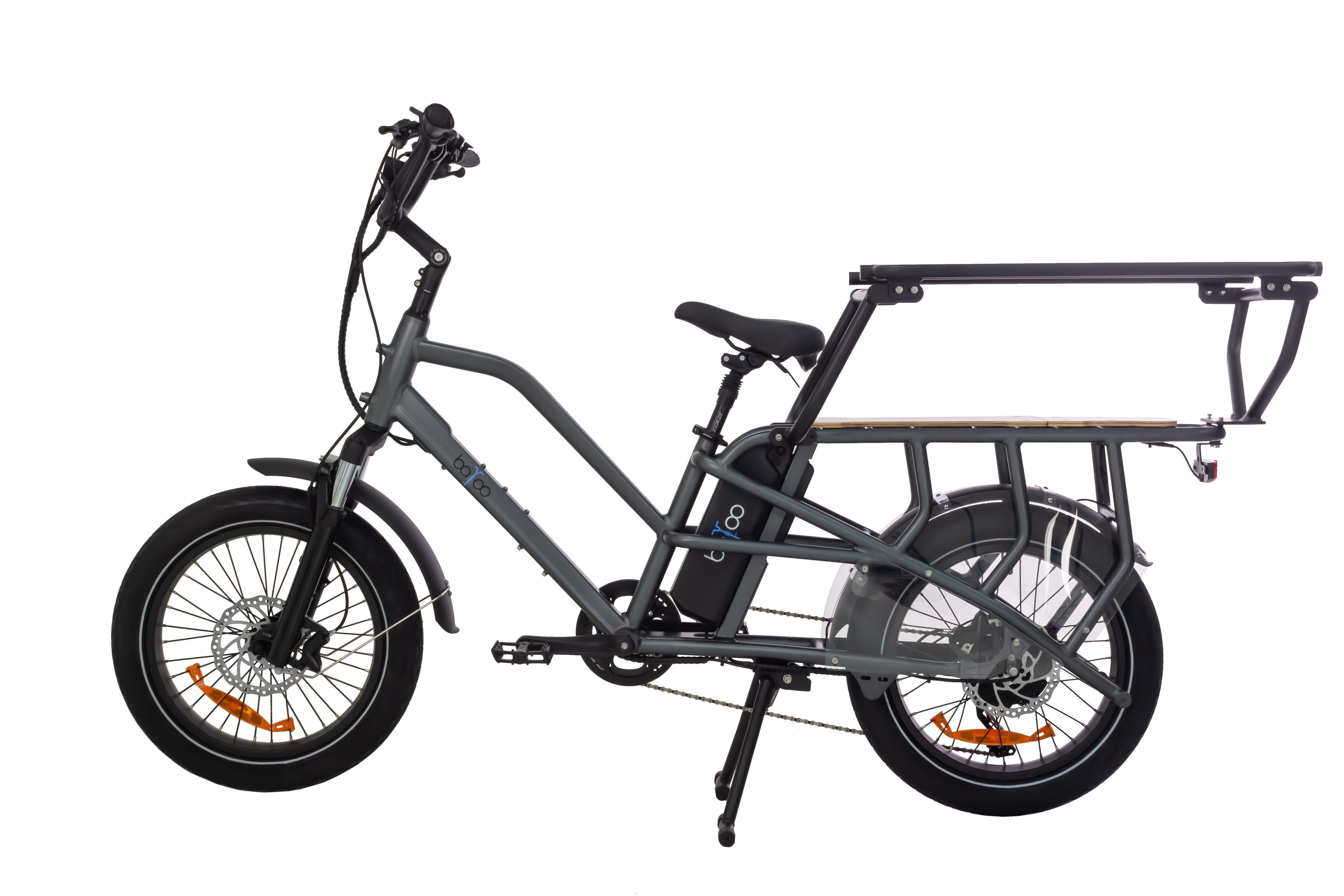
Can you travel with the Colibri V2.0 on the train?
The Colibri V2.0 is an electric cargo bike. It should therefore be considered with the precautions applicable to cargo bikes when planning a train journey.
Do not assume that its compact positioning means it will be accepted on any train.
Before traveling:
- measure the actual length of your setup;
- check the width with accessories installed;
- consult the category of each train;
- check the operating company;
- remove luggage before boarding;
- allow enough time for loading.
If you regularly plan to combine train and cargo bike travel, also test the bike's handling on foot before purchase.
Book a test ride and test cargo bike handling
Checklist before taking the train with a cargo bike
- ☐ I have checked that the route accepts bikes.
- ☐ I have checked the category of each train.
- ☐ On the SBB network, I prioritize RE, S or R trains.
- ☐ I have identified the company operating each train.
- ☐ I have checked the restrictions indicated in the timetable.
- ☐ I know the length and width of my cargo bike.
- ☐ I have purchased a valid ticket for the bike.
- ☐ I know if a reservation is offered or necessary.
- ☐ I can load and unload the bike myself.
- ☐ Luggage can be removed quickly.
- ☐ I have allowed enough time for changes.
- ☐ I know how to manage children during boarding.
- ☐ I have avoided peak hours if possible.
- ☐ I have a plan B if the train no longer has enough space.
Conclusion
Traveling by train with a cargo bike in Switzerland is possible, but it requires more preparation than with a regular bicycle.
On the SBB network, cargo bikes are considered special bicycles and are only allowed on RE, S, and R trains. On the BLS, RhB, and SOB networks, some IR trains may also accept them if space is available.
A bike ticket alone does not guarantee that your cargo bike will be able to board. You must check the train category, the operating company, passenger traffic, and the restrictions indicated in the timetable.
When traveling with children, simplify boarding as much as possible: remove luggage, plan sufficiently long connections, and organize in advance who will handle the bike and who will accompany the children.
Finally, when the journey involves several incompatible trains or complex changes, renting a bike at your destination can sometimes be much simpler than transporting your own cargo bike.
Frequently asked questions about cargo bikes on trains
Are cargo bikes accepted on InterCity trains?
Not on InterCity trains operated by SBB. Cargo bikes are considered special bicycles and are only allowed on the SBB network on RE, S, and R trains.
Is it necessary to reserve a space for a cargo bike?
Not systematically. Trains compatible with cargo bikes do not necessarily offer a reservation. Even with a valid ticket, transport remains subject to available space. Always check the pictograms and remarks in the timetable.
What ticket should I buy for the bike?
For a short journey, it is possible to buy a route ticket for the bike at the reduced price. A daily bike pass currently costs CHF 15.– and the annual bike pass CHF 260.–. The conditions of the transport company remain priority for a special bike.
Are longtails considered special bikes?
A longtail designed as a cargo bike may fall under the rules applicable to cargo bikes. Other bikes longer than two meters are also considered special. In case of doubt, check the dimensions and ask the operating company for confirmation.
What to do if the train is full?
The transport of a cargo bike is not guaranteed when there is insufficient space. You may have to wait for the next train, choose another route, or consider renting one at your destination.