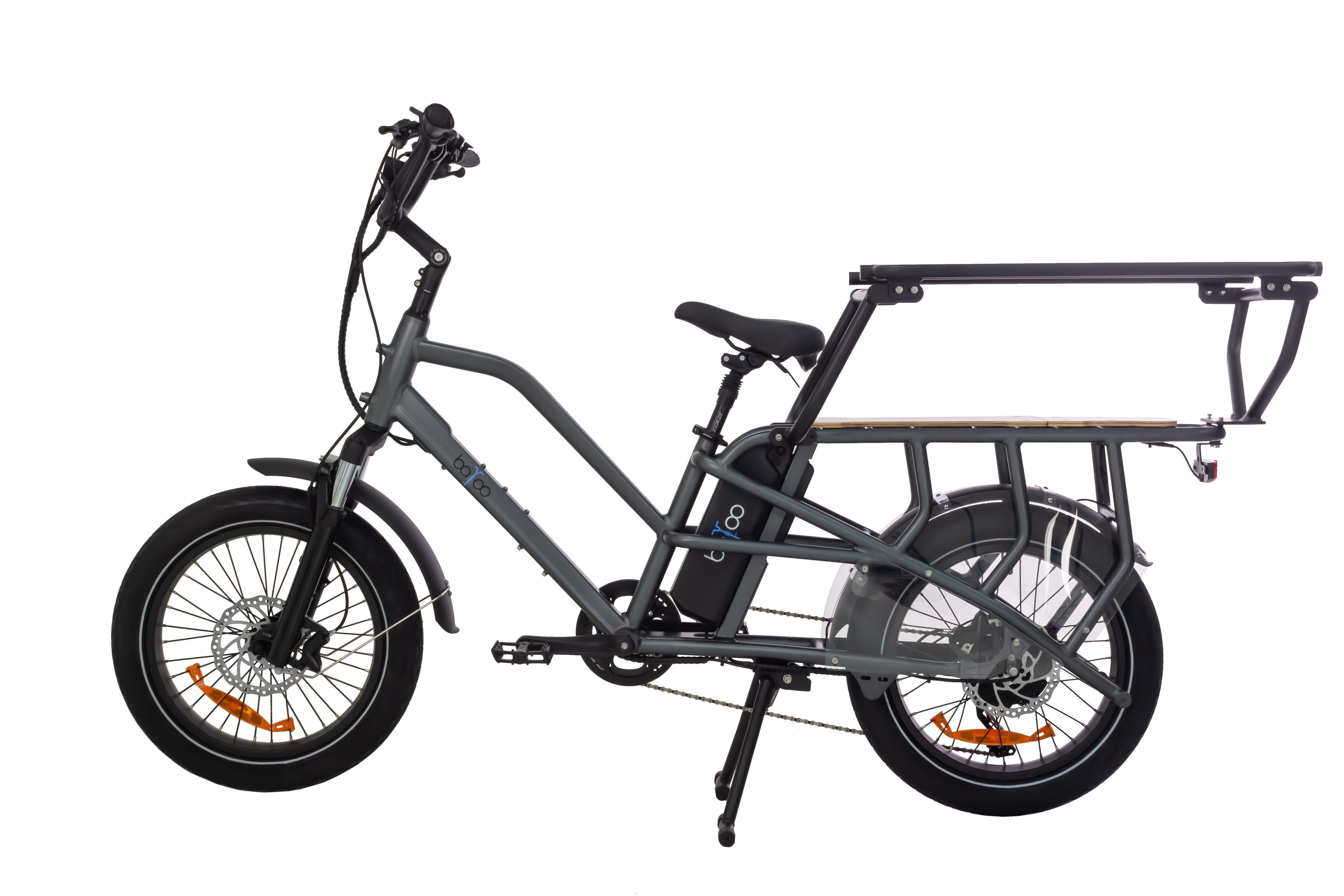
Installing a child seat on an electric bike allows you to make trips to daycare, school, or for daily errands without using a car. However, a seat advertised as compatible with electric bikes may not necessarily be installable on all models.
Compatibility depends on the type of attachment, frame shape, battery position, pannier rack, its maximum load, and the limits defined by the seat manufacturer.
Before any purchase, separately check the compatibility of the seat with the child, with the bike, and with the attachment system. A seat suitable for the child's weight may still be incompatible with the e-bike's pannier rack or frame.
Can a child seat be installed on all electric bikes?
No. Some electric bikes are perfectly compatible with a child seat, while others require a special adapter or do not allow any safe installation.
The main elements to check are:
- the type of seat: front or rear;
- the attachment method: stem, frame, or pannier rack;
- the shape and material of the frame;
- the width and capacity of the pannier rack;
- the battery position;
- the routing of cables and hoses;
- the child's maximum weight;
- the total authorized load of the bike.
The mention "e-bike compatible" is a first indicator, but it never replaces the seat's and bike's manuals. Both manufacturers must authorize the chosen configuration.
Which seat to choose based on the child's age and weight?
Age and weight limits vary by model. They must be respected even when the child still seems comfortable in the seat.
| Seat Type | Typical Use | Common Limit | Points to Check |
|---|---|---|---|
| Front seat | Young child able to hold their head up | Often up to approximately 15 kg | Stem, riding space, handlebar rotation, and visibility |
| Frame-mounted rear seat | Young child or older child | Often up to 22 kg | Shape, diameter, and material of the seat tube |
| Pannier rack-mounted rear seat | Daily commutes and family use | Often up to 22 kg | Pannier rack load, width, tubes, and battery |
| Cargo bike seat or bench | One or more children | Depending on the bike and equipment | Approved seats, harnesses, payload, and protection |
These values are indicative. The limit written on the seat and in its manual always takes precedence.
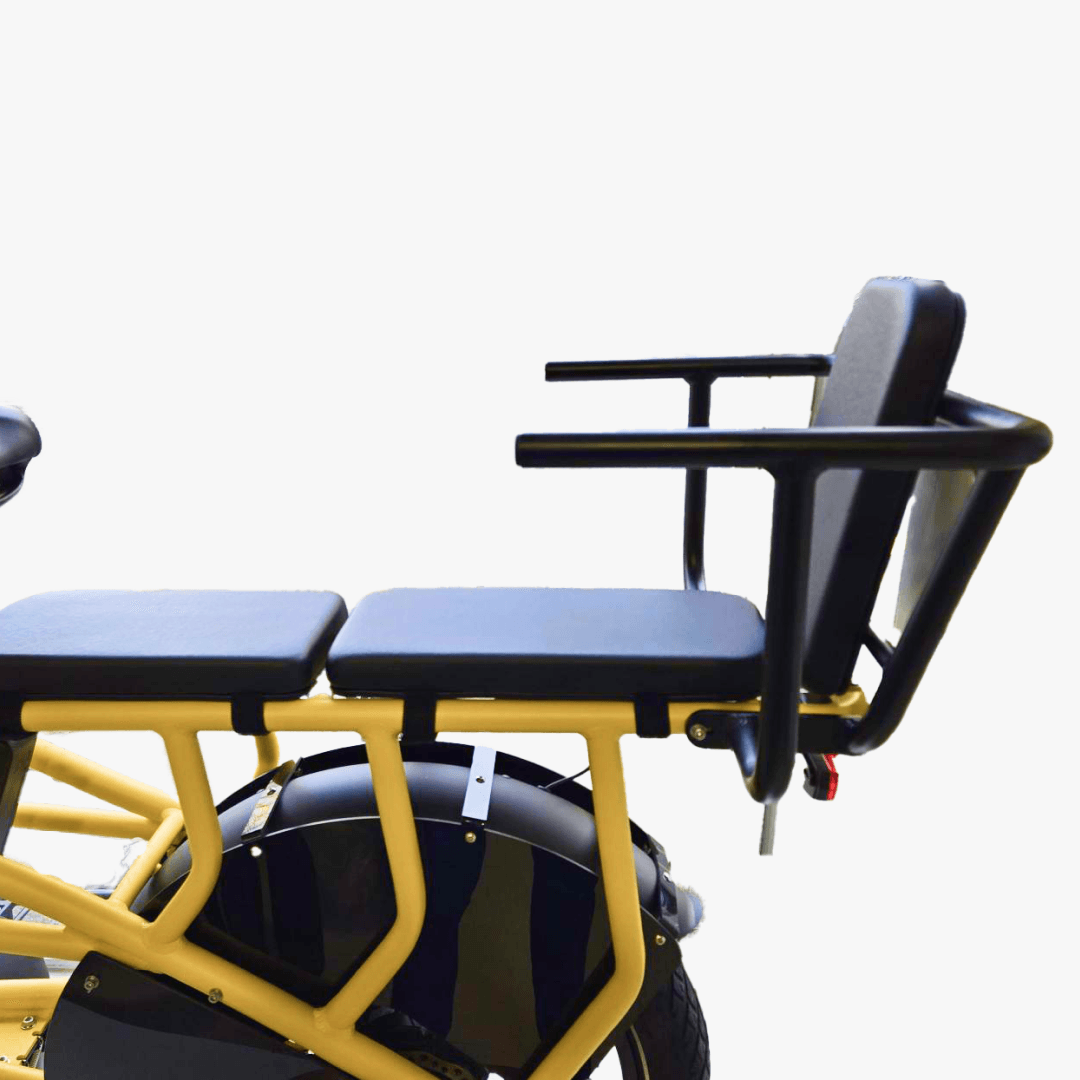
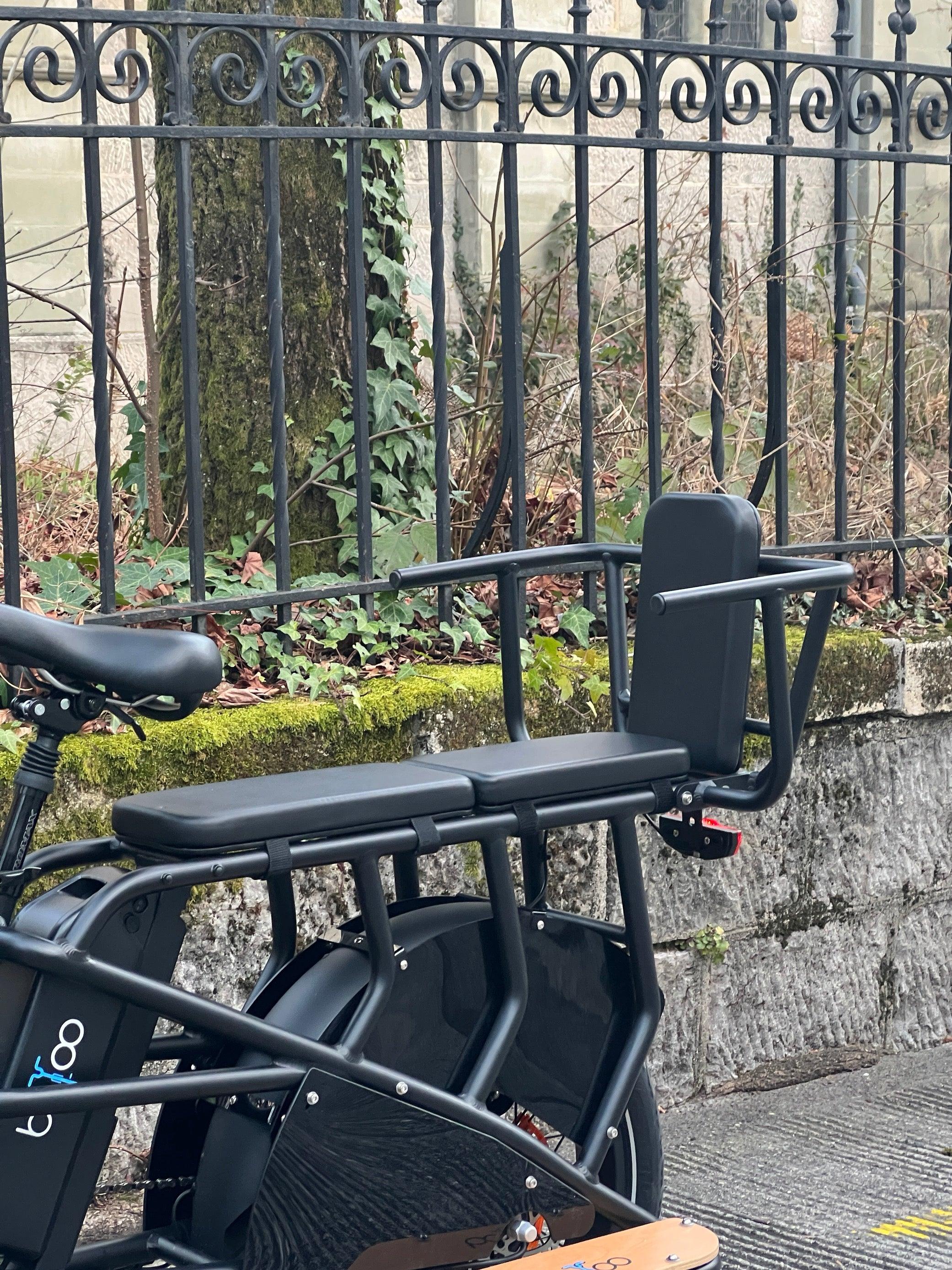
The Urban Iki rear seat offered by Batoo is suitable for children from 9 months to 6 years old, up to 22 kg or 110 cm. It features a pannier rack attachment system and a five-point harness.
This age range does not mean it automatically suits all children from nine months old. The child must be able to hold their head and body correctly. For younger children, also consult our guide on transporting a baby in a cargo bike.
Front seat or rear seat: what are the differences?
The front child seat
The front seat is usually fixed to the stem or a compatible part located behind the handlebars. It allows you to keep the child in your line of sight and facilitates communication during the ride.
Before choosing this solution, check that:
- the stem or head tube accepts the attachment system;
- the handlebars can turn freely in both directions;
- the rider's knees do not touch the seat;
- cables, hoses, and controls are not compressed;
- road visibility remains sufficient;
- the child cannot reach the controls.
The front seat is often reserved for lighter children. Its weight limit must be carefully checked.
The rear seat attached to the frame
A frame-mounted rear seat typically uses a bracket installed on the seat tube. It can be suitable for a bike without a pannier rack, provided the frame and its geometry are compatible.
This solution may be impossible when:
- the tube has an incompatible shape;
- the frame is carbon or made of a material excluded by the manufacturer;
- the bike has a rear suspension;
- cables occupy the attachment area;
- there is insufficient free space on the tube;
- the battery interferes with the bracket.
Do not move a cable or tighten a fastener on a sensitive frame without technical validation.
The rear seat attached to the pannier rack
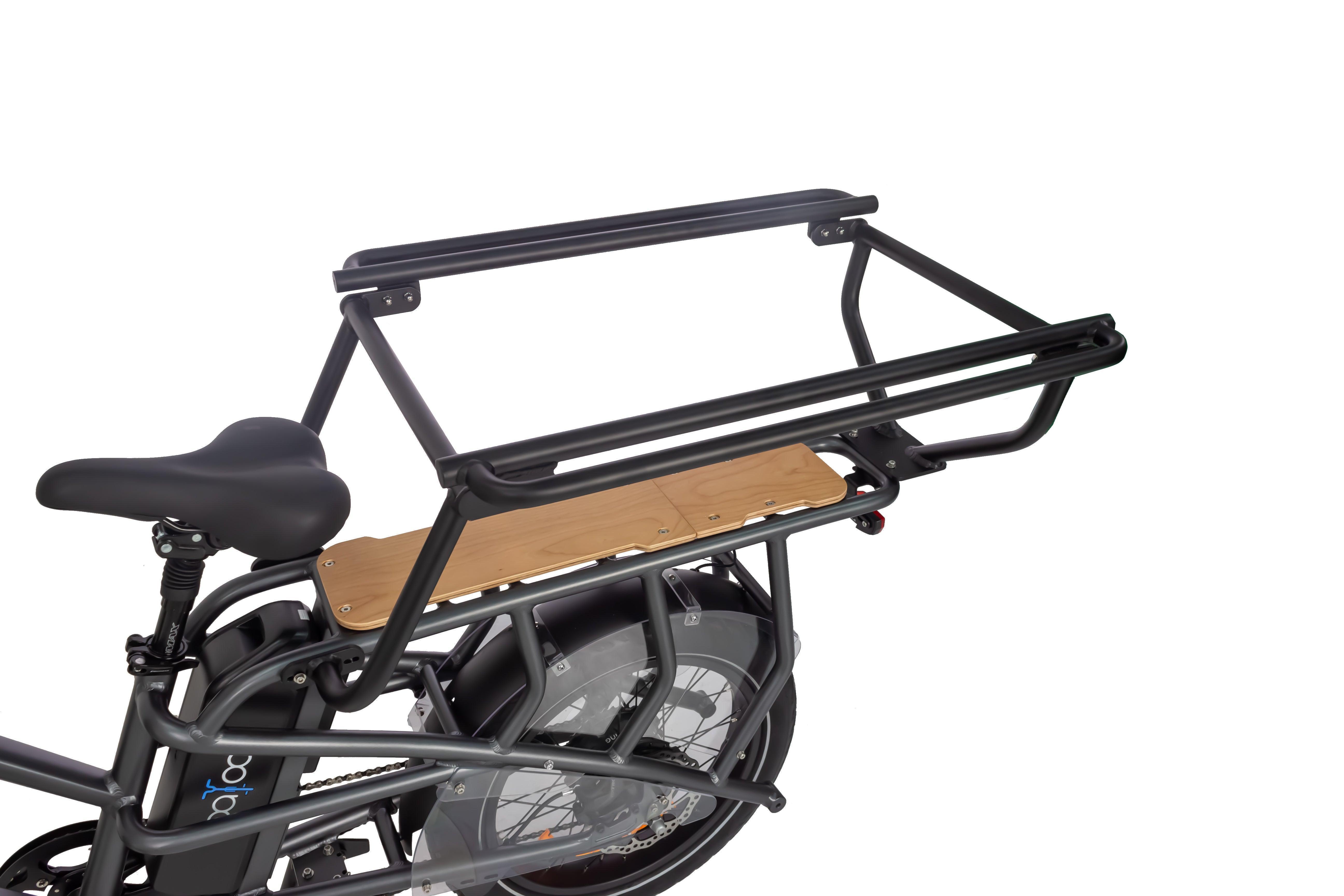
Pannier rack attachment is common on urban electric bikes. It can be simple and stable, but only when the pannier rack has been designed to support a child seat.
You need to check:
- the maximum authorized load;
- the compliance required by the seat manufacturer;
- the width of the pannier rack;
- the diameter of its tubes;
- compatibility with MIK, MIK HD, or equivalent systems;
- the available space above the battery;
- the complete locking of the system.
A pannier rack intended only for carrying a bag or a few groceries should not have a child seat attached without confirmation from the manufacturer.
What maximum weight should the pannier rack support?
There isn't a universal capacity valid for all seats. Some manufacturers require a pannier rack approved for a specific minimum load, for example, 25 or 27 kg.
The 22 kg limit indicated for the child therefore does not mean that a pannier rack advertised for 22 kg is automatically sufficient. You must also consider:
- the weight of the seat;
- the forces produced by the child's movements;
- the stresses related to road irregularities;
- the requirements of the attachment system;
- the total capacity of the bike.
Consult the plate, marking, or manual of the pannier rack. In the absence of clear indication, ask the manufacturer or a specialized workshop for confirmation.
Does a rear battery prevent seat installation?
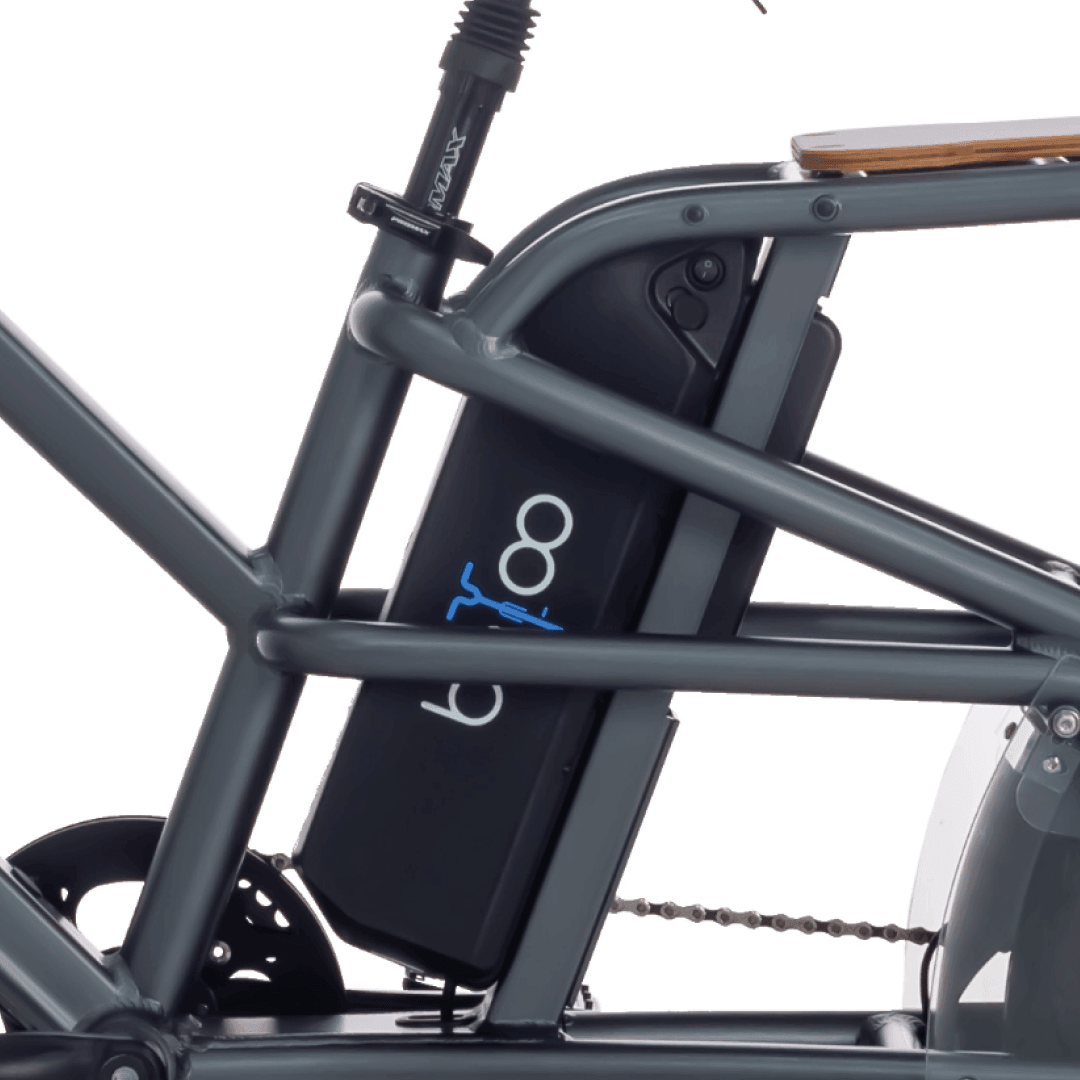
Not necessarily. Many electric bikes place the battery under the pannier rack while remaining compatible with certain child seats.
However, the presence of the battery may reduce available space or alter the dimensions of the pannier rack. Specifically check:
- that the attachment system can enclose or lock the pannier rack;
- that the seat does not rest directly on the battery;
- that the battery can still be removed without disassembling the seat;
- that the rails and connectors are not compressed;
- that the seat remains sufficiently far from the wheel;
- that the manufacturer authorizes this configuration.
An adapter can sometimes solve the problem, but only if it is designed for the specific seat and pannier rack.
How to calculate the total load of the electric bike?
The child's maximum weight is only part of the calculation. You must also check the total load authorized by the bike manufacturer.
Depending on the method used in the manual, the calculation may include:
- the rider's weight;
- the child's weight;
- the seat's weight;
- panniers and their contents;
- the lock;
- other accessories;
- the bike's weight itself.
Example: a seat authorized up to 22 kg cannot be used at this limit if the total weight of the configuration exceeds that authorized for the bike or the pannier rack.
Do not confuse the maximum load of the seat, that of the pannier rack, and the total authorized weight of the bike. These three limits must be respected simultaneously.
How does the child seat modify riding?
A child seated at the back shifts the bike's center of gravity upwards and backwards. The bike can become more difficult to keep upright when stopped and at low speeds.
This additional load influences:
- starting;
- balance at low speeds;
- braking distance;
- tight turns;
- maneuvers on foot;
- parking on the kickstand;
- battery range.
Before riding with the child, test the bike in a traffic-free area. Start with a similar load, then practice starting, braking, turning, and getting off the bike.
How to install and remove the child without tipping the bike?
A large part of the risk occurs when the bike is stationary. A child moving while the rider closes the harness can easily unbalance a bike resting on a flimsy kickstand.
To reduce this risk:
- Choose a flat and stable surface.
- Fully deploy the kickstand.
- Always hold the bike with one hand.
- Place the child in the seat before heavy bags if the configuration requires it.
- Immediately close the harness.
- Adjust the footrests and their straps.
- Never leave the child alone in the seat.
- Remove the child before loading or unloading bulky items.
A robust or double-legged kickstand generally facilitates installation. However, it does not replace the presence and support of the bike by an adult.
What safety equipment should be checked?
The harness
The Bureau for the Prevention of Accidents recommends choosing a seat with a five-point harness that the child cannot open alone.
The straps must support the body without passing over the neck. Check their adjustment each time the child wears different clothes.
The backrest
The BPA recommends a backrest of at least 40 cm. A sufficiently high backrest helps support the back and offers better protection around the child.
The footrests
Feet must be placed and held by appropriate straps. The child must never be able to reach the wheel, spokes, chain, or road surface.
The helmet
On a slow electric bike with assistance up to 25 km/h, a helmet is not legally mandatory, but it is highly recommended.
On a fast electric bike with assistance up to 45 km/h, wearing an approved helmet is mandatory for the rider and for the child in the seat.
The child's helmet must be adapted to their head circumference and not be pushed forward by the seat's backrest.
Clothing
Clothing, shoelaces, scarves, and bag straps must not be able to reach the wheels or moving parts. Also avoid very thick clothing that prevents proper harness adjustment.
What does Swiss regulation say?
In Switzerland, the person transporting a child by bike must be at least 16 years old. The child must be placed on a seat or protected area adapted to the vehicle.
Helmet rules vary depending on the electric bike category:
- Slow electric bike up to 25 km/h: helmet recommended, but not mandatory.
- Fast electric bike up to 45 km/h: approved helmet mandatory for the rider and for the child in the seat.
The seat should comply with standard EN 14344 and bear clear information about the manufacturer, manufacturing date, and maximum authorized weight.
You can consult the recommendations of the Bureau for the Prevention of Accidents on child bike seats as well as the Swiss rules regarding electric bikes.
Checklist before each trip
- ☐ The seat is compatible with the bike and its attachment system.
- ☐ The child's weight remains below the seat's limit.
- ☐ The pannier rack supports the load required by the manufacturer.
- ☐ The fasteners are tightened and fully locked.
- ☐ The seat does not move laterally.
- ☐ The battery and its cables are not compressed.
- ☐ The harness is correctly closed and adjusted.
- ☐ The footrests and their straps are adjusted.
- ☐ Hands and feet cannot reach the wheels.
- ☐ The helmet is correctly positioned.
- ☐ No clothing or objects hang near moving parts.
- ☐ Tires and brakes are in good condition.
- ☐ Lights are working.
- ☐ Bags are secured and do not interfere with the seat.
- ☐ The bike is stable before installing the child.
When to choose a cargo bike or trailer instead?
A classic child seat is well suited for transporting a single child when the bike, seat, and pannier rack are compatible.
A cargo bike equipped for child transport can become more practical when:
- you are transporting two or more children;
- you have many bags or groceries;
- the rear load makes the bike difficult to balance;
- the pannier rack is not compatible;
- you want to keep children in a protected space;
- you make daily school or daycare trips.
A trailer can be another solution, especially when the bike is compatible with a suitable hitch. However, it requires checking the load, braking, visibility, and manufacturers' instructions.
Test the configuration before daily use
A technical sheet does not fully allow judging the balance of a loaded bike. During a test, check:
- the ease of installing the child;
- the stability of the kickstand;
- straddling the bike;
- starting with a load;
- maneuverability at low speed;
- braking;
- available space for bags;
- ease of battery removal;
- storing the bike at home.
When the classic seat reaches its limits, you can also test the Colibri V2.0 electric cargo bike with a configuration close to your real family use.
Book a free test ride with your family configuration
Conclusion
A child seat can be installed on many electric bikes, but compatibility should never be assumed.
Before the first ride, check the attachment system, pannier rack capacity, child's weight, total bike load, battery position, and manufacturers' instructions.
A well-chosen seat must remain stable, allow proper harness adjustment, and protect the child's hands and feet. The bike must also remain sufficiently maneuverable when starting, braking, and stopping.
In case of doubt, have the installation checked by a specialized workshop and test the loaded bike in a protected area before riding in traffic.
Frequently asked questions about child seats for electric bikes
Are all child seats compatible with an electric bike?
No. Compatibility depends on the type of attachment, the frame, the rack, the battery position, and the limits set by the manufacturers. The mention "e-bike compatible" is not enough to confirm a precise installation.
What maximum weight should a luggage rack support?
The minimum capacity depends on the seat. Some manufacturers require a rack approved for at least 25 or 27 kg. Check the seat's manual and the rack's marking rather than relying solely on the child's weight.
Can a child seat be installed if the battery is at the rear?
Yes, in some cases. There must be enough space for the attachment, without compressing the battery or its connectors, and respecting the authorized dimensions. An adapter may be necessary depending on the seat and the rack.
From what age can a bike seat be used?
You must follow the limit indicated by the manufacturer and check that the child correctly holds their head and body. Many seats start around nine months, but the most cautious recommendation is to wait until the child's development allows for a stable position.
Is a cargo bike more stable with two children?
A cargo bike designed to transport several children generally offers a more suitable configuration than a classic bike equipped with a single seat. However, actual stability depends on the format, weight distribution, payload, and the rider's skill.