A 4-seater cargo bike can become a real alternative to a car for taking children to school, going to daycare, doing groceries, or organizing weekend trips.
However, the "4-seater" designation does not guarantee that four children can travel comfortably in all configurations. The actual capacity depends on the manufacturer's authorized seats, the children's age, the payload, harnesses, internal dimensions, and remaining space for school bags and groceries.
The best 4-seater cargo bike is one that can accommodate your entire family today, as well as when the children have grown up. Therefore, before purchasing, you need to test all four seats, calculate the total load, and check the bike's dimensions under your real-world conditions.
What does "4-seater cargo bike" actually mean?
The term "4-seater cargo bike" can have several meanings depending on the manufacturer or reseller:
- four seats reserved for children in the box;
- three child seats plus the driver's seat;
- a bench advertised for four young children;
- several possible configurations depending on the installed seats;
- a maximum capacity that varies according to the age and size of the passengers.
Before comparing two models, therefore, check what the manufacturer counts as a seat.
A genuine child seat should particularly include:
- a seat designed by the manufacturer;
- an appropriate restraint system;
- sufficient shoulder and legroom;
- protection against wheels and moving parts;
- a position compatible with the bike's payload.
An added cushion in the box or free space between two children does not automatically constitute an authorized seat.
Can four children be transported on a cargo bike in Switzerland?
In Switzerland, a conventional cargo bike or a slow electric cargo bike can transport up to four children if the vehicle has four protected seats equipped with seatbelts.
For slow electric cargo bikes, this possibility applies since the new rules came into force on July 1, 2025.
The maximum legal number does not override the limits indicated by the manufacturer. The most restrictive value among the following must always be respected:
- the number of authorized seats on the bike;
- the maximum payload;
- the maximum total vehicle weight;
- the limit for each seat or bench;
- restrictions related to installed accessories;
- instructions in the user manual.
The Swiss Council for Accident Prevention recommends a five-point harness connected to the frame for each child transported in a cargo bike. The box must be sturdy, and children must not be able to reach the road, wheels, or other moving parts with their hands or feet.
Also consult our guide on child safety on cargo bikes.
Are four advertised seats actually usable?
A bench may accommodate four young children without offering enough space when two of them reach school age.
The actual capacity depends notably on:
- available shoulder width;
- seat depth;
- leg and shoe room;
- thickness of winter clothing;
- presence of a baby seat;
- individual harness positions;
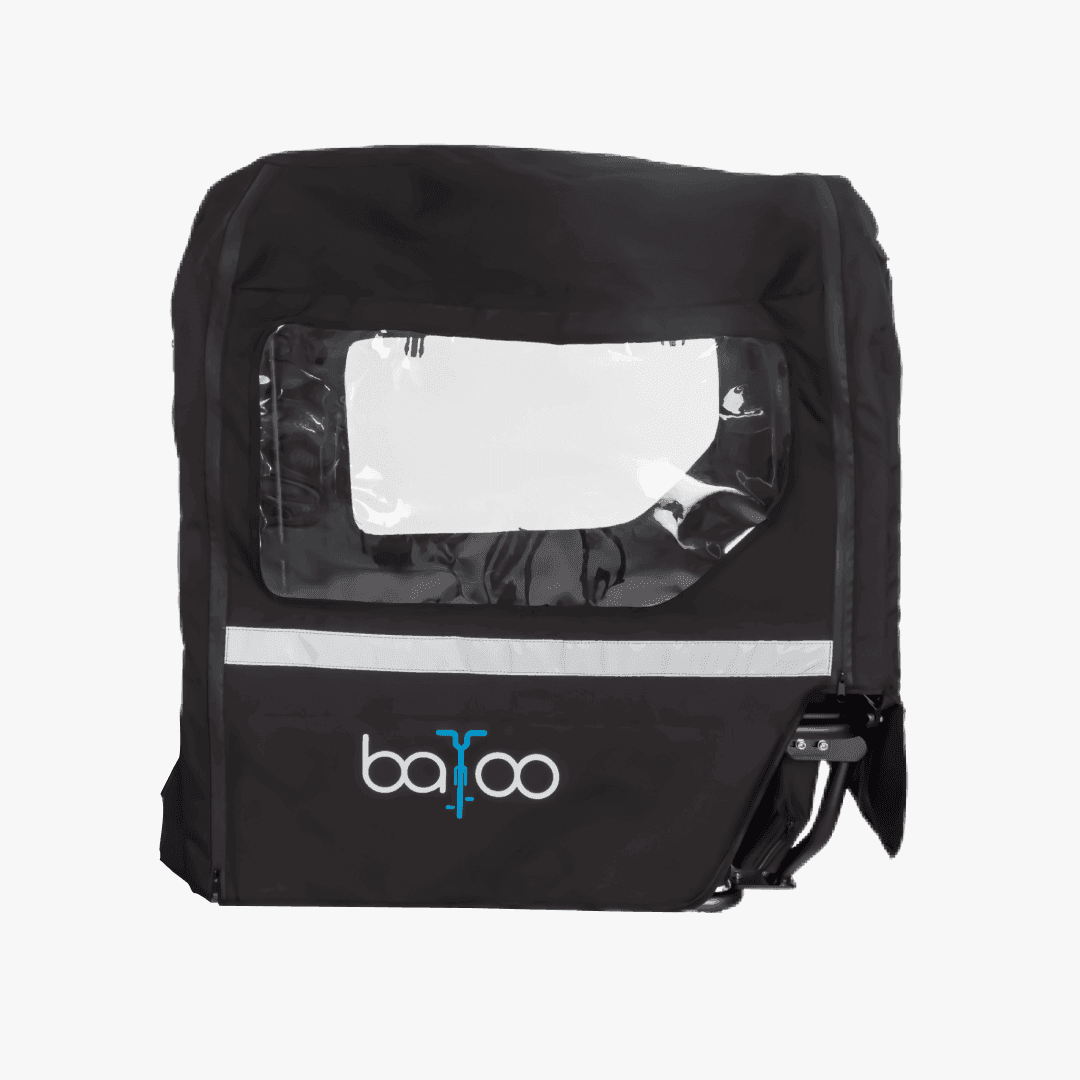
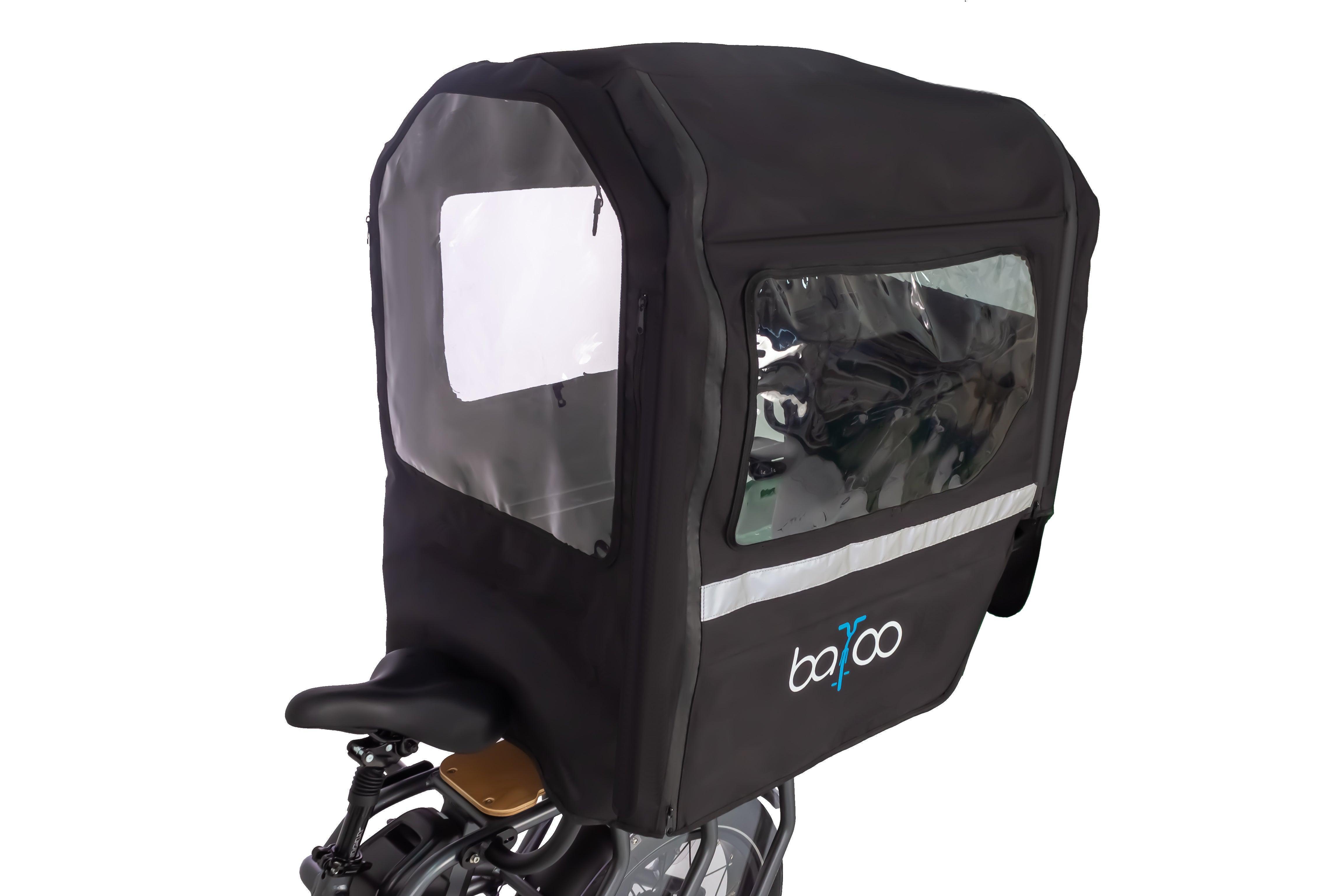
- height under the rain cover;
- space occupied by school bags.
A configuration suitable for four children aged two to six may no longer be appropriate when two passengers are over 130 cm tall.
You should also check if children can get on and off without stepping on seatbelts, moving seats, or unbalancing the bike.
Longtail, two-wheeler, or three-wheeler: which format to choose?
| Format | Family Configuration | Advantages | Limits to check |
|---|---|---|---|
| Longtail | Often two children at the back, sometimes supplemented by a front seat | Compact, narrow, and similar to a conventional bike | Four actual seats are rare and space for bags is limited |
| Two-wheeler | Several children in a box placed at the front | Children visible, relatively low center of gravity, and good family volume | Length, interior width, and turning radius |
| Three-wheeler | Large box that can offer several seats depending on the model | Stable when stopped and spacious | Width, cornering behavior, and access to premises |
The longtail
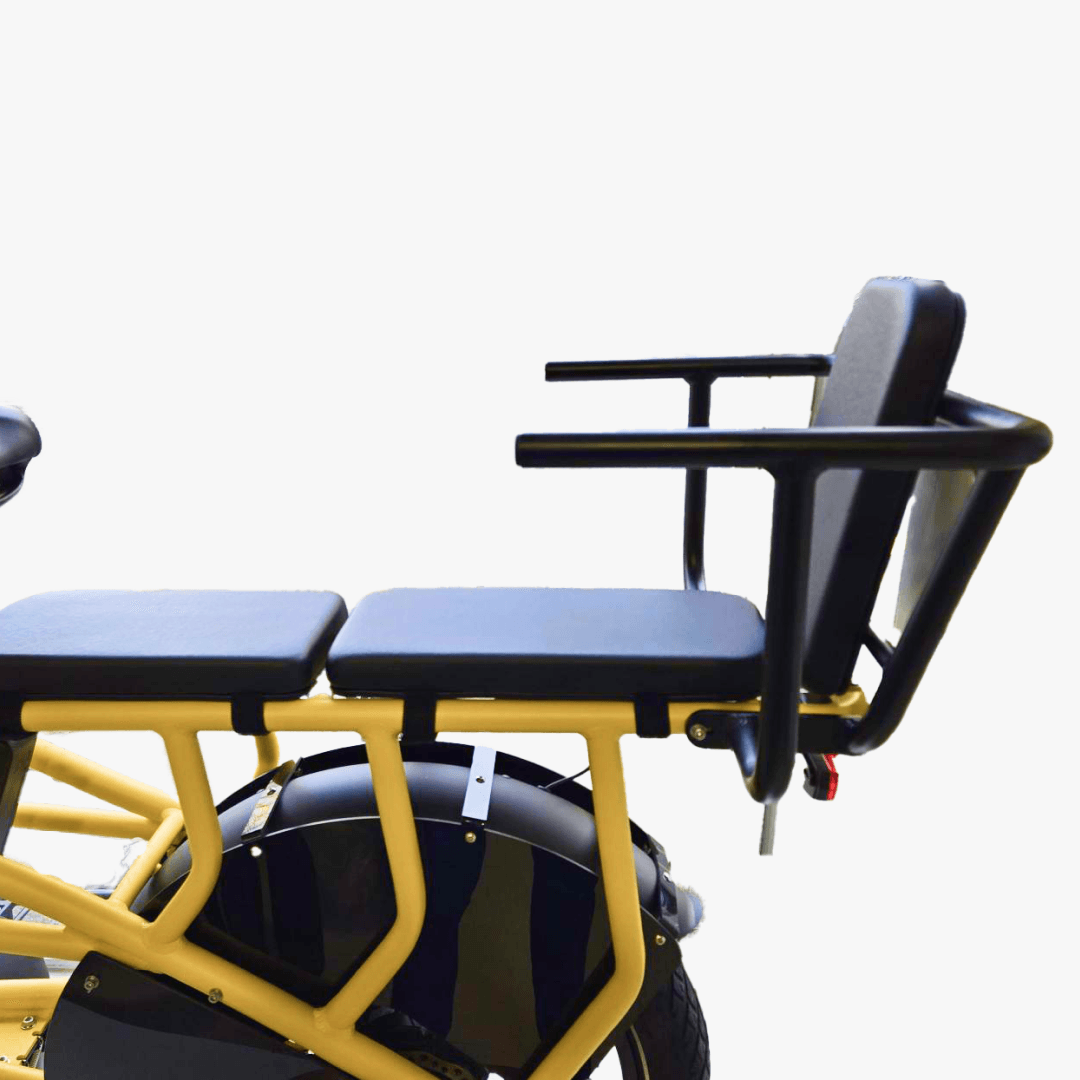
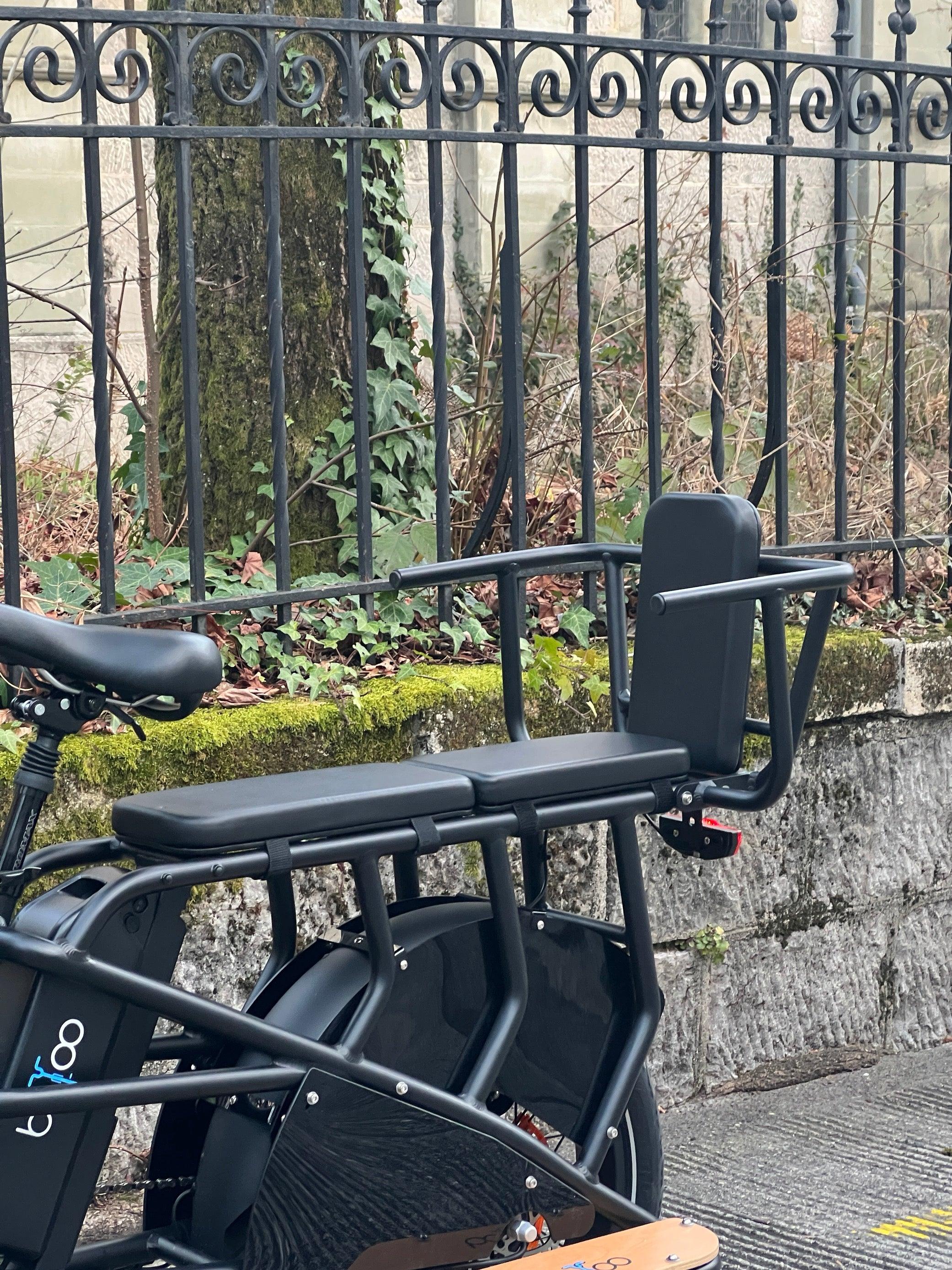
The longtail has an extended rear rack. Its ride generally remains similar to that of a traditional bike, and its narrowness makes it easy to pass on bike paths, through doors, and in bike storage areas.
It is often suitable for one or two children. A configuration with three children may sometimes be provided by the manufacturer, especially with a front seat.
However, a longtail offering four genuinely authorized child seats is less common. Pay close attention to:
- the authorized number of passengers;
- the load of the rack;
- seat compatibility;
- available foot space;
- stability during installation.
The two-wheeler
The two-wheeler has two wheels and a box placed between the handlebars and the front wheel. It generally offers a good compromise between family capacity and dynamic behavior.
Depending on its dimensions and approval, the box can accommodate several children on one or two benches.
For four seats, examine:
- the interior width of the box;
- the position of the two benches;
- the presence of four separate harnesses;
- the space between the children's knees;
- ease of access to the front and rear seats;
- the height available under the rain cover.
The two-wheeler is longer than a conventional bicycle. Therefore, measure access to the storage area, garage, and parking spot before purchasing.
The three-wheeler
The three-wheeler has three wheels and a generally wider box. It can offer significant volume for several children and remain stable when the driver installs passengers.
However, its handling requires adaptation. You need to slow down on turns and avoid sudden changes in direction.
Before choosing a three-wheeler, test:
- sharp turns;
- inclined passages;
- curbs and speed bumps;
- bike path entrances;
- door widths;
- maneuvers in your storage space.
Which configuration to choose based on children's age?
| Family Composition | Configuration to Examine | Key Criteria |
|---|---|---|
| One baby and three young children | Two-wheeler or three-wheeler with expressly compatible baby support | Support, vibrations, remaining width, and payload |
| Four preschool-aged children | Box with four separate seats and harnesses | Access, legroom, and ventilation |
| Two young children and two older children | Model with differentiated seats or authorized combination | Shoulder width, weight, and height under the hood |
| Four school-aged children | High-payload bike with large seats | Total weight, interior space, braking, and range |
When a baby is part of the configuration, their seat or support may occupy more space than a standard seat.
Consult our guide on transporting a baby in a cargo bike before choosing an installation.
For a family with three children, also find our comparison dedicated to cargo bikes for three children.
How to calculate the payload of a 4-seater cargo bike?
The presence of four seats does not guarantee that the bike can carry four children of any weight with groceries and accessories.
Consult the manual to know exactly what the manufacturer includes in the payload and the maximum authorized total weight.
Depending on the model, the calculation may include:
- the driver;
- the four children;
- seats and benches;
- the rain cover;
- school bags;
- groceries;
- panniers;
- locks;
- other accessories.
Indicative example of family loading:
- child 1: 27 kg;
- child 2: 23 kg;
- child 3: 18 kg;
- child 4: 14 kg;
- school bags and clothes: 14 kg;
- groceries and accessories: 12 kg.
This configuration already represents 108 kg of passengers and cargo, before adding any other elements potentially included in the manufacturer's calculation.
Do not confuse:
- the maximum load of the box;
- the bike's payload;
- the maximum authorized total weight;
- the capacity of each seat;
- the number of available seats.
All these limits must be respected simultaneously.
What dimensions should be measured before purchase?
External dimensions determine if the bike can be ridden and stored easily. Internal dimensions determine if children can travel comfortably.
Interior dimensions
In the box, measure or check:
- the width of each bench;
- the depth of the seat;
- legroom;
- the distance between the two rows;
- the height under the rain cover;
- the space occupied by harnesses;
- the remaining space with a baby seat.
Exterior dimensions
For your home and trips, check:
- the total length of the bike;
- its maximum width;
- the width with the rain cover;
- the turning radius;
- the space required for the kickstand;
- the possibility of moving the bike on foot.
Access to the storage room or garage
Also measure:
- the width of the doors;
- the length of the available space;
- turns in corridors;
- the slope of ramps;
- the size of the elevator;
- steps or thresholds to cross;
- the space needed to install children.
A bike suitable for the road can become very restrictive if you have to perform multiple maneuvers or remove the hood daily to store it.
Which motor to choose for a loaded cargo bike?
In Switzerland, a slow electric bike can have a motor with a maximum power of 500 W and assistance up to 25 km/h.
However, for transporting several children, nominal power should not be the only criterion. Torque, progressive assistance, and starting behavior are also important.
For family use, check:
- available torque at low speed;
- smooth starting;
- assistance on climbs;
- bike control in slow maneuvers;
- after-sales service availability;
- ease of system maintenance.
A very responsive motor can be useful on climbs, but assistance must remain predictable when the bike is carrying four children.
Which brakes should be preferred?
With four children and luggage, the total mass of the bike increases significantly. Braking must therefore be powerful, progressive, and easily controllable.
Prioritize:
- hydraulic brakes adapted to the load;
- appropriately sized discs;
- components for which wear parts are available;
- easy-to-operate levers;
- regular maintenance of pads and discs.
During the test ride, test progressive deceleration and a firmer stop with a representative load, in an area closed to traffic.
Braking distance increases on wet roads, downhill, or when tires lack grip. Always maintain an extra safety margin with passengers.
What range to expect with four children?
The range advertised by a manufacturer is generally measured under specific conditions. It does not necessarily correspond to a family trip with four children, climbs, and frequent stops.
Actual range depends notably on:
- the weight transported;
- the terrain;
- the level of assistance;
- the temperature;
- the wind;
- tire pressure;
- the number of starts;
- bike maintenance;
- battery age.
Calculate your needs based on the most demanding day, not the shortest trip.
Plan enough reserve for:
- an unforeseen detour;
- an extra climb;
- a low temperature;
- heavier groceries;
- a forgotten charge;
- the gradual decrease in battery capacity.
A second battery can be useful for long distances or hilly routes, but it adds weight and increases the total cost. The need should be evaluated based on your actual use.
What equipment should be planned for four children?
The bike alone is not always enough. A complete family setup may require:
- four seats authorized by the manufacturer;
- a five-point harness for each child;
- hand and foot protection;
- a sufficiently ventilated rain cover;
- a robust kickstand;
- footrests or adapted access;
- separate panniers for school bags;
- permanent lighting;
- reflective elements;
- a rearview mirror where it improves visibility;
- an anti-theft device appropriate for the bike's value;
- a secure parking solution.
Bags should not be placed in front of children's feet or prevent harnesses from closing.
How to distribute children and luggage?
Place children only in the seats provided for them. Heavier passengers should be installed according to the manufacturer's recommendations to maintain stable weight distribution.
Heavy objects should be:
- placed as low as possible;
- evenly distributed;
- separated from the children;
- fastened to prevent any movement;
- kept away from buckles and harnesses.
Avoid hanging a heavy bag on only one side of the handlebars or the box. An asymmetrical load can alter direction and complicate slow maneuvers.
What budget should you plan for a complete setup?
The price displayed for the bike does not always represent the final cost of a 4-seat setup.
Add to the budget:
- additional benches or seats;
- harnesses;
- rain cover;
- footrests;
- panniers;
- locks;
- insurance;
- annual maintenance;
- replacement tires and brake pads;
- a potential second battery.
Request a quote for the complete configuration used by your family. This will allow you to compare models based on their actual functional cost, not just their base price.
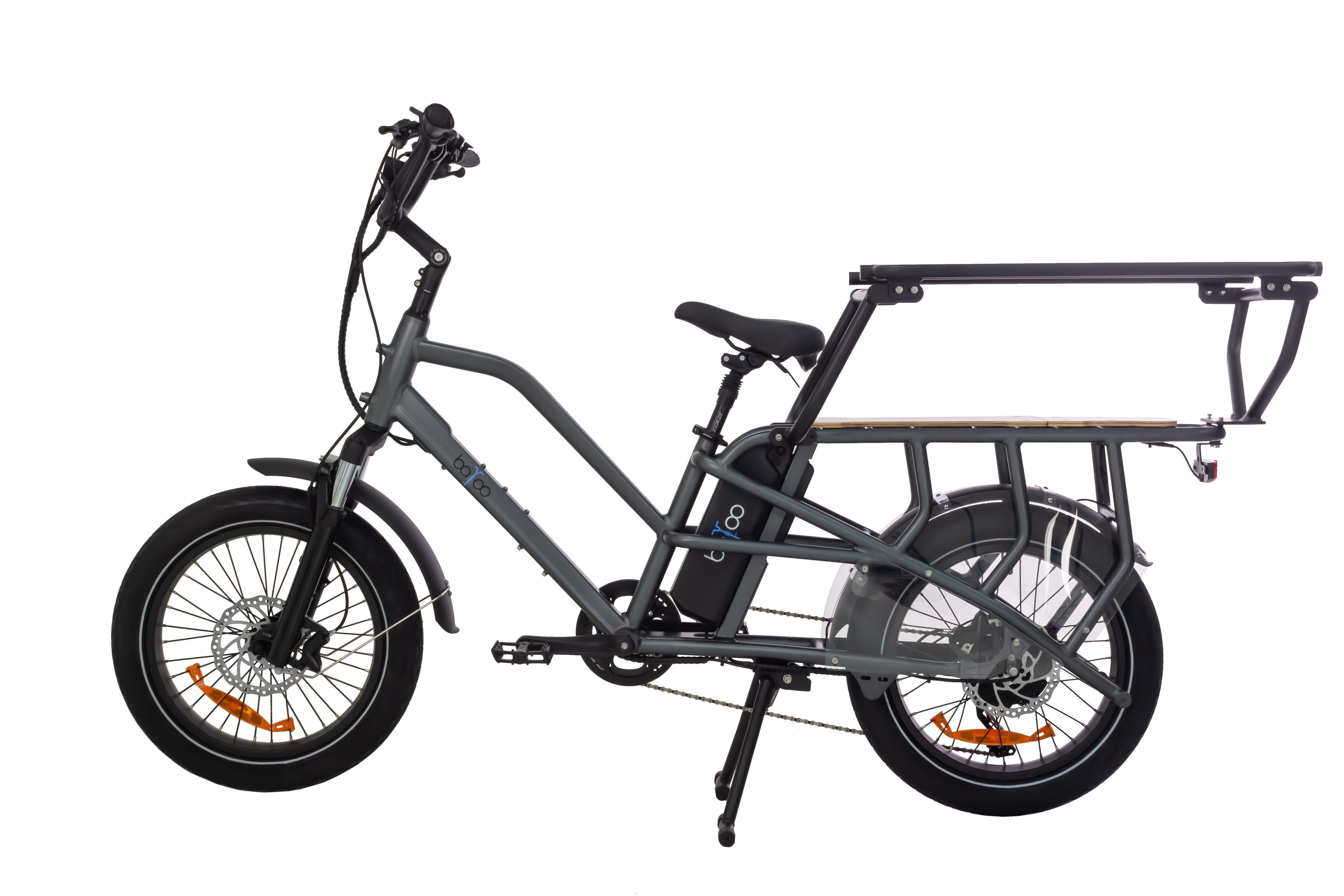
Is the Colibri V2.0 suitable for your family configuration?
The current product sheet for the Colibri V2.0 electric cargo bike features:
- a 500 W and 85 Nm Bafang motor;
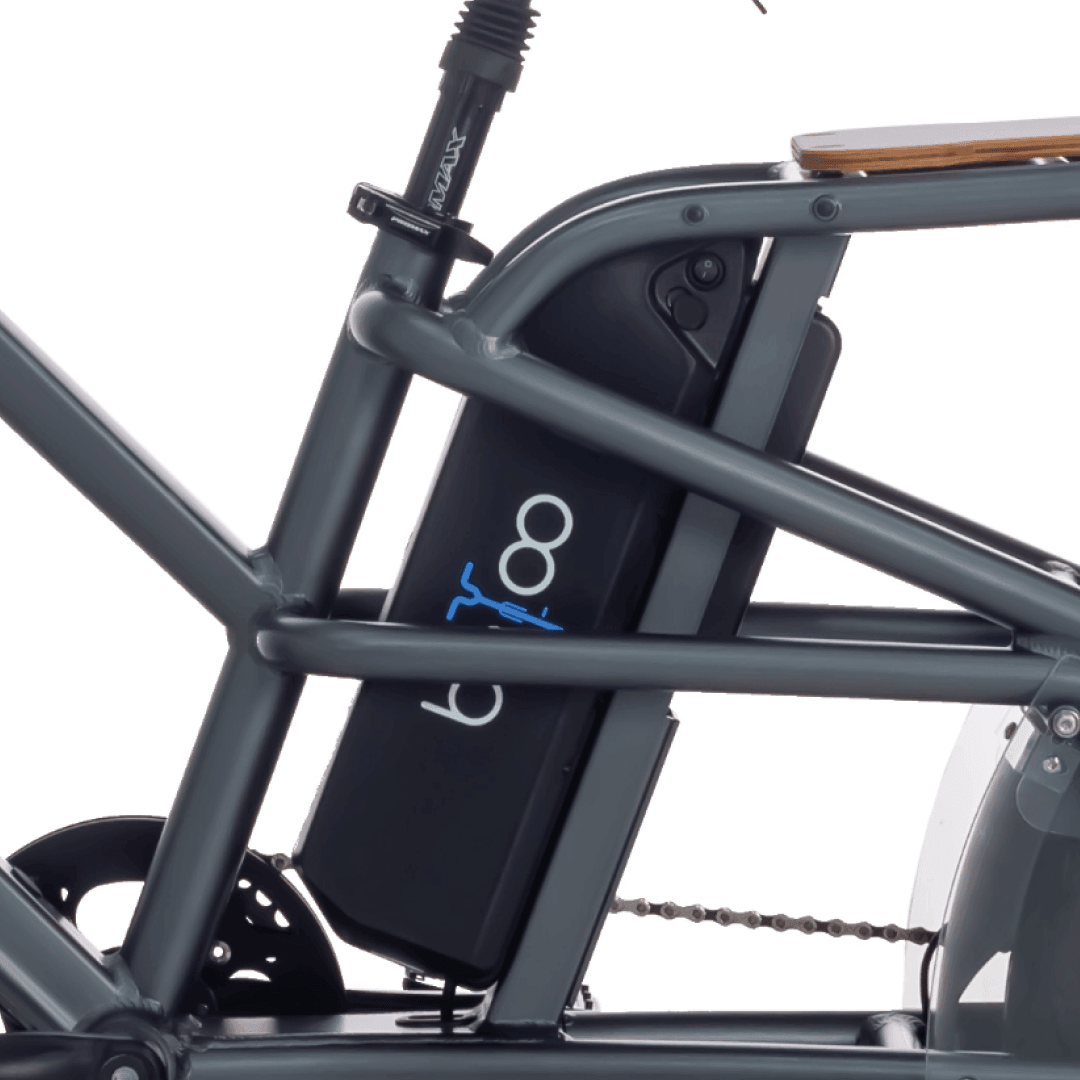
- a removable 720 Wh battery;
- a dual battery configuration of 1,440 Wh;
- four-piston hydraulic brakes;
- 20 × 3 inch tires;
- a suspended front fork;
- an advertised payload capacity of up to 160 kg;
- an advertised range of up to 120 km.
These characteristics allow for evaluating the bike's performance, but they are not sufficient to confirm a precise configuration with four children.
Before use, ask Batoo to confirm:
- the exact number of authorized child seats;
- compatible benches and harnesses;
- the payload calculation method;
- the maximum weight distribution;
- necessary accessories based on the children's age.
Checklist for trying out a 4-seat cargo bike
- ☐ All four seats are expressly authorized by the manufacturer.
- ☐ Each child has their own harness.
- ☐ Children have enough shoulder room.
- ☐ Their legs and shoes do not get in the way.
- ☐ The youngest child's seat is compatible.
- ☐ The rain cover closes without touching the passengers.
- ☐ School bags have separate storage.
- ☐ The payload remains sufficient with groceries.
- ☐ Uphill starts remain smooth.
- ☐ Braking remains progressive and controllable.
- ☐ The bike can handle the turns on your route.
- ☐ The kickstand remains stable during installation.
- ☐ The bike fits in your bike room or garage.
- ☐ The range covers your most demanding day.
- ☐ The rider remains comfortable with a full load.
Why should you try the bike with the whole family?
An empty test does not allow you to measure the maneuverability, braking, and comfort of a loaded bike.
Whenever possible, come to the test ride with:
- all four children;
- their helmets;
- their school bags;
- the youngest child's seat or support;
- the bags used daily.
Test the bike on a configuration similar to your actual route: starting, climbing, turning, braking, parking, and accessing your premises.
You can also consult our general guide for choosing between a longtail, a two-wheeler, and a three-wheeler.
Book a test ride with your family's full configuration
Conclusion
A 4-seat cargo bike should not be chosen solely based on the advertised number of seats.
To be truly suitable for a large family, it must offer four authorized seats, individual harnesses, sufficient payload, comfortable space, and braking adapted to the weight carried.
The longtail remains appealing for its compactness, the two-wheeler for its balance between capacity and maneuverability, and the three-wheeler for its volume and stability when stopped. The best format depends on the children's age, your housing, your commutes, and daily cargo.
Before purchasing, measure your storage space, calculate the full load, and conduct a test ride with the children and their equipment. This verification remains the best way to know if the four seats are truly usable by your family.
Frequently asked questions about 4-seat cargo bikes
Can four children travel at the same time in a cargo bike?
Yes, in Switzerland, a conventional or slow electric cargo bike can transport up to four children when it has four protected seats equipped with belts. It is also necessary to respect the number of seats, the payload, and the limits set by the manufacturer.
What payload is needed for a family of five?
There is no single value. You need to add up the elements included by the manufacturer in their calculation: rider, children, seats, accessories, school bags, and groceries. The complete configuration must remain below the authorized payload and total weight.
Does a 4-seat cargo bike fit in a bike room?
That depends on its length, width, and turning radius. Measure doors, corridors, location, ramps, and the space needed to deploy the kickstand before purchasing.
What motor should I choose to transport four children uphill?
Power alone is not enough to determine performance. Also check torque, assistance smoothness, and starting behavior. In Switzerland, a slow electric bicycle can have a motor of up to 500 W with assistance limited to 25 km/h.
What range can I expect with a loaded bike?
Range depends on weight, terrain, temperature, assistance level, wind, and tire pressure. Use the most demanding route as a reference and keep a margin for detours and unfavorable conditions.